23 Sep
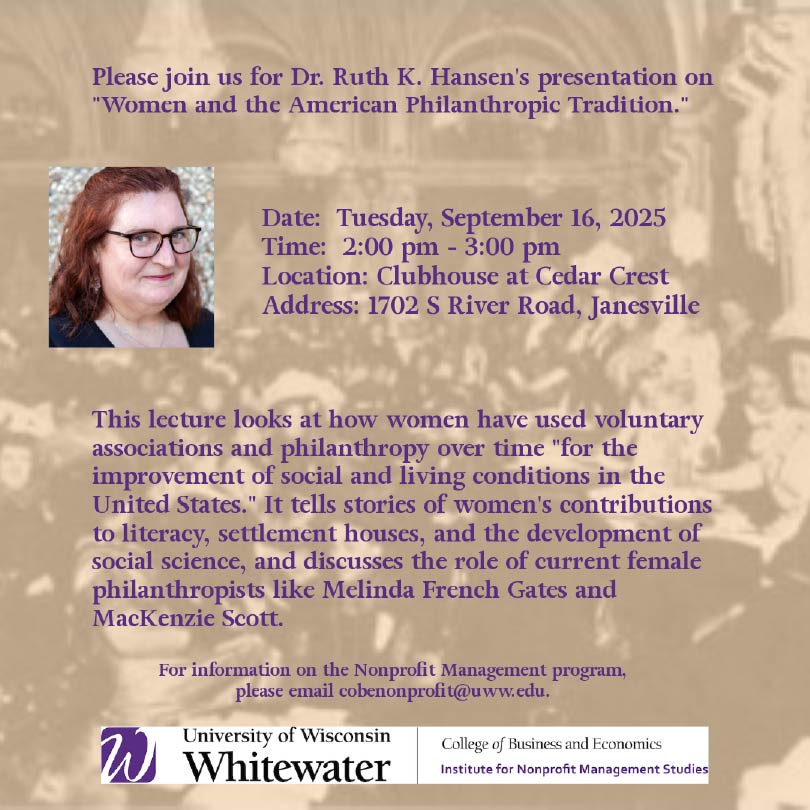
INMS Schedule of Events for 2026-27
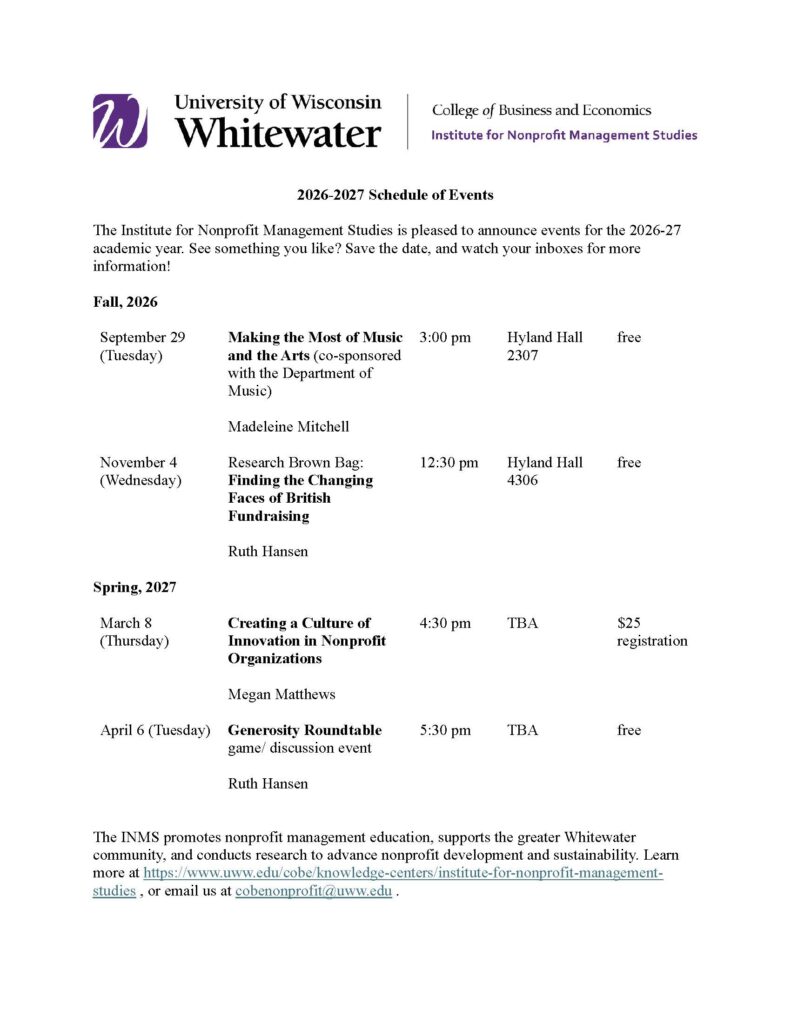
Alyssa Ostrenga graduated on Saturday, May 16, 2026 with a major in communications and a minor in nonprofit management. She was also inducted into the Nu Lambda Mu International Honor Society for nonprofit management scholars.
Alyssa is putting her skills to use as the full time Program and Events Coordinator for the Fort Atkinson Community Center, “an independent, multi-purpose, nonprofit center that serves the community, neighbors, and visitors of Fort Atkinson, WI”. This beautifully renovated, historic space on the Rock River is a great asset to the area, and Alyssa’s management ensures that the facility’s users have an excellent experience!
We offer Alyssa our best wishes for a fulfilling career and joyous life!

“Well, in all my years I ain’t never heard, seen nor smelled an issue that was so dangerous it couldn’t be talked about. …I’m for debating anything.” (RI delegate Stephen Hopkins in “1776”, by Edwards & Stone)
Have you ever been asked to write a grant proposal on commission? (I have.)
Have you ever been part of a board where someone recommends asking someone to do fundraising labor on commission? (I have.)
Because I have been a fundraising professional for a long time, and a member of AFP for (also) a long time, I responded, in each instance, that that practice is considered unethical behavior – and was met with both embarrassment and surprise from the people suggesting it. They asked, how can this be?
(Rolled up in that, of course, is that nobody likes the suggestion that they are unethical, especially when they’re trying to help a good cause.)
Commission-based pay for fundraisers is considered unethical in the US; but professional codes in the UK and Australia have changed to allow the practice. And, as my experiences (and those of others) show, many good-meaning people in the US aren’t familiar with our professional expectations.
So it seems a good time for a thorough examination of arguments for, against, and about the issue. This report from Rogare (authored by Ian MacQuillin MCIOF(Dip) (UK), Heather Hill, CNM, CFRE (US), Roewen Wishart (Australia), and myself) does that. We pick it up, turn it around, and examine it from all the angles we could think of, including that of the fundraisers as employees. We don’t argue for the practice, or against it; our goal is to examine the arguments of others. However, we do identify several potential “danger zones,” including the effect on fundraisers’ well-being. We also offer some possible mitigating safeguards for those working in contexts where professional codes allow commission-based pay.
Even those of us who sign professional ethics codes that repudiate commission-based fundraising can be – and some have been – asked to participate in the practice. If you’ve ever wondered “why” – or wondered about the arguments for or against – this candid exploration may be of interest.
Download Playing the Percentages report
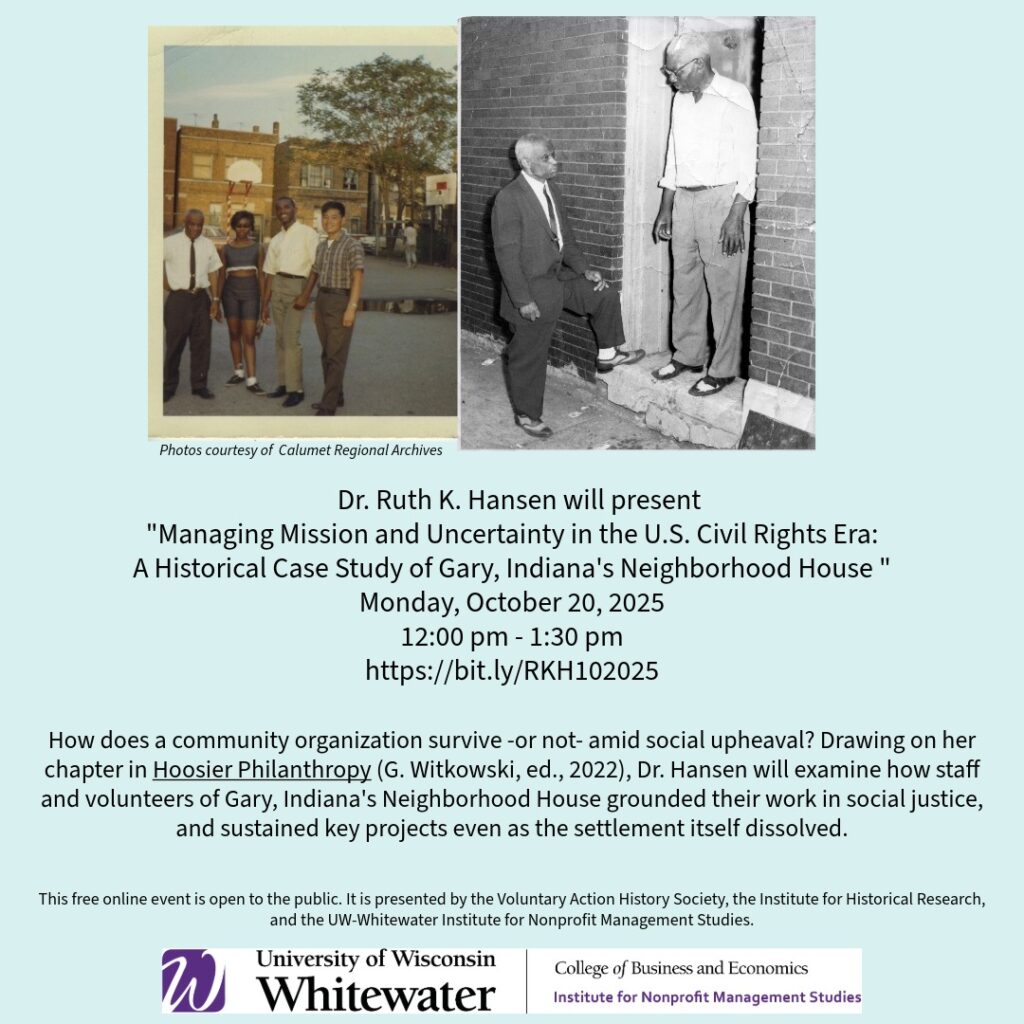
Join us on Monday, October 20, 12:00 pm – 1:30 pm Central for Dr. Ruth K. Hansen’s presentation on “Managing Mission and Uncertainty in the U.S. Civil Rights Era”. This free online presentation is open to the public and can be accessed at https://bit.ly/RKH102025. Dr. Hansen will present a historical case study exploring how the staff and volunteers at Gary, Indiana’s Neighborhood House responded intentionally to environmental dynamics of race, politics, and shifting resources.
I’ll be honest: I probably think a lot more about nonprofit revenues than the average person. While federal grants to nonprofits such as arts organizations, research universities, comprehensive colleges and universities, and human services organizations are often publicized, it’s rare that they gain much notice, let alone make national and international headlines.
I happen to spend a lot of time thinking about nonprofit revenue portfolios. So given the current interest in payments from the federal government to a nonprofit organizations, I decided that it was time for a post about government grants and contracts. I worked with similar grants for charitable organizations for more than a dozen years in my capacity as a fundraiser. I have served as a reviewer for state and federal grants. Now I study and teach about nonprofit management, fundraising, and the limits of people’s willingness to help others.
Government grants and contracts account for an average of one third of nonprofit revenues in the US – the second most important source of nonprofit revenue, behind fees for service. Private philanthropy provides approximately 14% of nonprofit revenues to the sector as a whole (National Council on Nonprofits, 2019).
Every dollar of government support is money that has been allocated, usually by congress or state legislatures, to address specific goals for the public benefit. These nonprofit organizations are doing work our elected representatives have decided is important. There is a high degree of transparency about how the money is used, with reporting back to the government and to the public.
There’s a difference between a church and a religiously affiliated organization. Federal money will not fund churches for programs that are worship, or propagating a faith. Religious congregations rely almost entirely on philanthropy for their revenue – more charitable dollars go to support religion than any other category of organization (Giving USA, 2024).
Many religious denominations have teachings that instruct the faithful to care for others. It’s not surprising that many human services, health, and education organizations have roots in religious traditions, but they are still human services, health and education organizations. When their activities match a goal identified by government – such as providing counseling to domestic abuse victims, administering a program such as assistance with utilities, or providing academic support to students who are from low to moderate income backgrounds – their religious ties are not a barrier to receiving government funding.
Large nonprofits have organizational audits, release annual reports, and file informational returns with the IRS that are publicly available. Federal grants sometimes also have their own audits as part of the regular process. A negative finding in the audit can affect the organization’s ability to receive federal funds in the future.
The process is one with a great deal of transparency. Staff of the granting agencies, the nonprofit organizations, and the IRS all take great care with the taxpayer money that our elected representatives decided should be used to benefit the public. Better yet, there are processes in place to dissuade, discover, and remedy any improper use. While fraud can happen, the individuals involved can face jail time, and there is the potential loss of future federal funding for the organization.
So the federal grant process is an unlikely venue for money laundering. However, if your goals include relieving human suffering, promoting health, supporting vulnerable populations, improving education, or advancing research — then federal grants to nonprofit organizations are a good, process- and kid-tested, mother-approved, approach to addressing some of the most important issues facing American society.
 In 2023/2024, the Institute for Nonprofit Management Studies (INMS) partnered with these organizations and more: United Way of Jefferson & North Walworth Counties, Whitewater Area League of Women Voters, Janesville Choral Union, Friends of the Effigy Mounds, Wisconsin local & regional arts organizations, University of Wisconsin – Parkside, and University of Delaware.
This is what our partners had to say about INMS:
 “Over the past couple of years, the collaboration between the INMS and the United Way of Jefferson & North Walworth Counties has resulted in the development of targeted training programs, resource-sharing initiatives, and joint funding opportunities, significantly enhancing the operational capacity and community impact of local nonprofits. Their combined efforts have increased organizational efficiency and fostered a more connected and resilient nonprofit sector in the region.” – Elizabeth Ellis-Bols, Director, United Way of Jefferson and North Walworth Counties
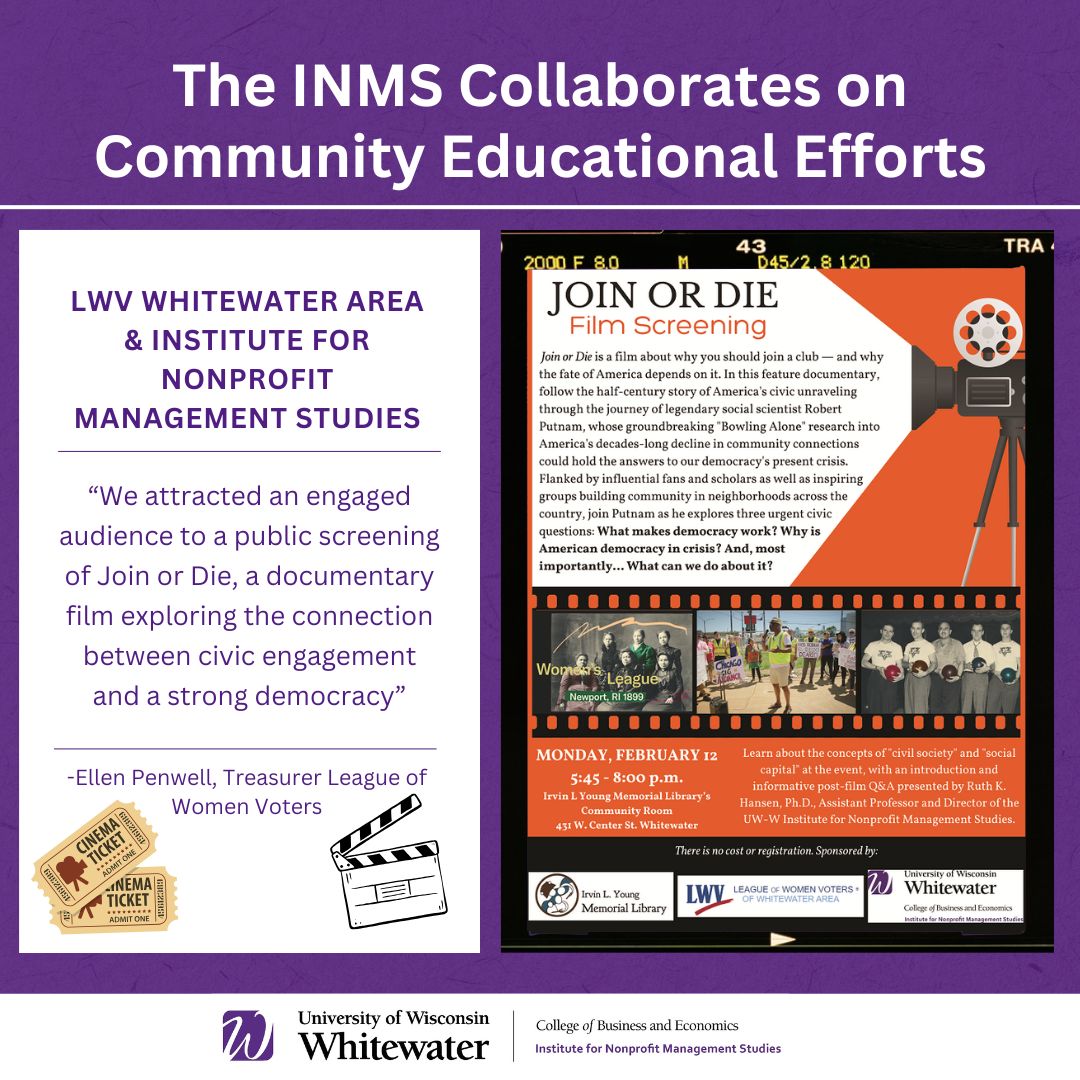
 “The LWV Whitewater Area benefitted greatly from its partnership with the Institute of Nonprofit Management Studies in February 2024. By joining resources, we attracted a strong audience to a public screen of Join or Die, a documentary film exploring the connection between community engagement and a strong democracy.” – Ellen Penwell, Treasurer, League of Women Voters Whitewater Area
Welcome to the 2024/2025 academic year in the College of Business and Economics at the University of Wisconsin-Whitewater! We are proud to announce that the Institute for Nonprofit Management Studies is in its 5th year of promoting nonprofit management education, supporting the Whitewater community through student interns and consultation, conducting research to advance nonprofit organizations’ development and effectiveness, and sharing those insights through professional development sessions and articles.
The nonprofit sector is the third largest workforce in America and nonprofits are a driving force for community engagement, positive change, and increasing equitability and quality of life. An education in nonprofit management can prepare you for a fulfilling career serving the public and creating a better world.
Sometimes we hear that people are surprised to learn that nonprofits employ people, or that one can earn a living wage at a nonprofit organization. According to new data from the Bureau of Labor Statistics (BLS), in 2022, about 6.5% of all employed people in the US worked for a nonprofit organization. The proportion in Wisconsin is a little higher than the national average.
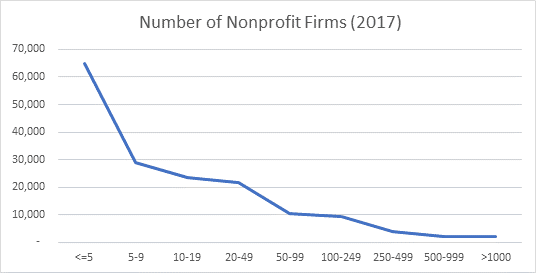
It is true that the vast majority of nonprofits are small. In terms of employment, 39% of nonprofits that have any paid employees have fewer than 5, as shown in this analysis from 2017.
However, if you’re planning to work in the nonprofit sector, chances are good that you’ll wind up at an organization that is a larger employer. 84% of nonprofit employees work at an organization that employs at least 100 people, and over half work at organizations that have at least 1,000 employees.
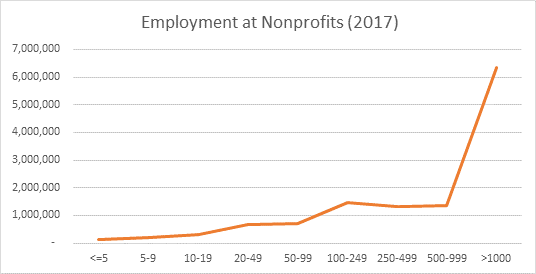
BLS analysis shows that the largest employers in the nonprofit sector tend to be in education or health care. In Wisconsin, 92.5% of hospitals are nonprofits, so that would hold true here.
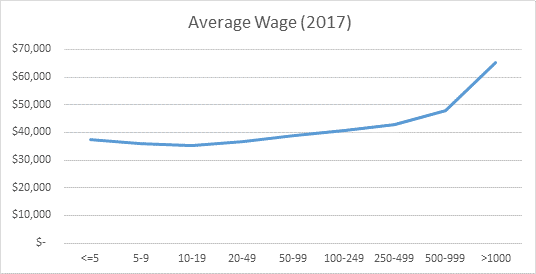
The average wage tends to increase with the size of the organization, as well. This chart with BLS data from 2017 shows that while the average wage at an organization that employs 1-5 people was $37, 360, including both professional and non-professional staff, at a very large organization that average wage jumped to $65,330. For comparison, the average wage nationally in 2017 for all non-government jobs was $55,338, and $53,667 for nonprofits.
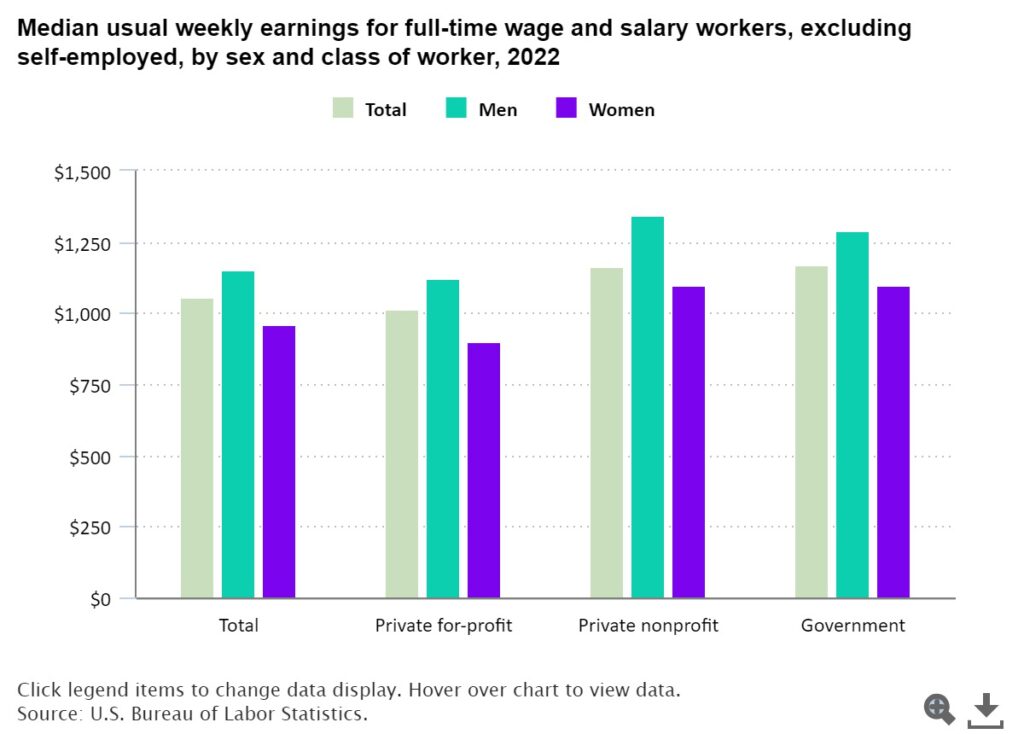
And in 2022, the median usual weekly earning for full-time workers was a healthy $1,163, higher than the median in the for-profit sector, and similar to the median in the government sector.
Among employer types, you’re more likely to hold a management or professional position in a nonprofit setting than any other kind of employer, according to BLS data from 2022. So it’s not surprising that nonprofit employees also tend to be highly educated — nearly 2 in 3 have at least a Bachelor’s degree, and more than one-quarter hold a Master’s. Members of the nonprofit workforce are also very likely to hold professional certifications. And this sector can also bring a great deal of flexibility as an employer – more than 19% of people employed by nonprofit organizations work part time. Only people who are self-employed have a higher proportion of part-time workers.
In short, not only can one find paid employment within the sector, it is one in which many people find and build fulfilling careers.
For resources on finding nonprofit jobs in the area, see our post https://blogs.uww.edu/nonprofit/2022/12/09/looking-for-work-in-the-nonprofit-sector/
For information about educational programs at UW-W that focus on nonprofit management, see https://www.uww.edu/cobe/departments/department-of-management/nonprofit-management
© 2026 Nonprofit@UWW | Entries (RSS) and Comments (RSS)
Powered by Wordpress, design by Web4 Sudoku, based on Pinkline by GPS Gazette