Search inside: Google Book Search

Google Book Search lets you search inside the contents of books, which can help you identify books very relevant to research you’re doing. The advanced search option lets you search for specific titles, authors, publishers, etc. Even if the University Library is closed or you are far away, you may be able to use this resource to read from a book’s text.

How much can you read online?

Well, it depends.
Full text of titles either out of copyright or provided with permission of the author(s) is available. Titles still under copyright and not readable in their entirety online may have selected preview pages (with publisher or author permission) or more limited “snippets.” Preview content may include the book’s table of contents, selected pages, and “popular passages.” Snippets are brief sentences surrounding your search word(s), but that can be enough to tell you if you want to borrow the book, either from the UWW University Library, another UW library (using the free Universal Borrowing service), or, if necessary, from libraries beyond the UW System using the ILLiad interlibrary loan service ($1 per requested book). In some cases, however, all you can see is a description of the book.

  • Full Text Examples: Machiavelli’s The Prince. Some government publications are included also, e.g., read the entire report Losing a million minds: Confronting the tragedy of Alzheimer’s disease and other dementias, published by the U.S. Congress Office of Technology Assessment in 1987.
  • Preview Pages Example: Taboo tunes: A history of banned bands & censored songs (2004) has selected preview pages available and allows the text of the book to be searched for snippets (using the “Search in this book” box).
  • No Preview Options Example: Ads to icons: How advertising succeeds in a multimedia age (2007) does not provide any preview pages or snippets. But you can read a summary of the book and use that to decide whether to look for the book’s availability.

How does Google get the books and documents?

From publisher, author, and library partners like the University of Wisconsin-Madison, and several others. Read more about Google Book Search online.

What can you do with it?

The most important advantage is identifying books most relevant to research you’re doing, and sometimes you can see enough text to answer a question or get a useful quote (be careful not to use something without enough context to be sure you understand it correctly!). It’s also possible to create a personal, customized online “library” of titles through Google Book Search, which can be shared with others along with your ratings and reviews (see also LibraryThing, especially for fiction, discussed in a previous blog entry).
Posted in around the world, tips for research | Tagged , | 1 Comment

Use E-books?

If you haven’t noticed, the Library loves surveys. (As an aside – a big thank you to all that completed the LibQUAL survey! We will going through the results and come up a plan of action to improve our resources and services based on the feedback we’ve received.)

eBrary, an electronic book vendor, also has a survey going about university students and their needs and usage of e-books. The survey doesn’t take much time to complete (it’s Spring Break and it’s snowing – you might have some time on your hands) and for your efforts, you’re entered into a drawing for an iPod of your choice. Pretty sweet, huh?

eBrary’s Student E-Book Survey

Thanks to Dianne for passing this along!

Posted in around the world | Tagged , , | Comments Off on Use E-books?

New Stuff Tuesday – March 25

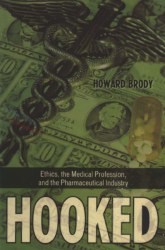
Hooked

Hooked:
Ethics, the Medical Profession, and the Pharmaceutical Industry
by Howard Brody
R724 .B76 2007
New Book Island, 2nd floor

Have you ever wondered why doctors prescribe some medications over another, even if they claim to have the same effect? This week’s featured book takes a look at the medical profession and its interactions with the pharmaceutical industry. The book’s introduction uses an interesting metaphor to describe the behavior of medical professionals. The author, professor at the University of Texas Medical Branch in Galveston, likens their situation to being in a stage production. The general public views doctors while they are ‘on stage’ and do not see their behind-the-scenes dealings with the pharmaceutical industry ‘back stage.’ Brody contends that what the public doesn’t see may actually hurt them. This book delves into each aspect of the doctor-pharma relationship, such as the quality of pharmaceutical research, the suppression of research findings and the role of drug sales representatives. He then looks to offer solutions to correct the corruption between the two. If you’re looking for a complete view of the medical profession operates with respect to drug companies, then this book’s for you.

Posted in new stuff tuesdays | Tagged , , , , | Comments Off on New Stuff Tuesday – March 25

Library Hours for Spring Break

Please note the University Library’s Spring Break hours:

  • We close at 4:30pm on Fri., Mar. 21st
  • We are closed over the weekend of Mar. 22-23
  • We are open 8am-4:30pm for the week Mar. 24-28
  • We are closed Sat. Mar. 29th
  • We are open only 6pm-midnight on Sun. Mar. 30th

Normal semester hours resume on Monday, March 31st.

Remember that the Library Catalog (which contains many links to online books and government documents) and article databases are available when the Library is closed.

You can renew checked out items online by logging into your “Personal Record” with your 7-digit UWW ID number and your last name. Students may renew items once, unless another patron has requested an item. If you have questions or difficulties with this service, please contact the Circulation Desk (262-472-5511 or email circdesk@uww.edu).

Posted in around the library, online @ the library | Tagged , , , | Comments Off on Library Hours for Spring Break

March: Women’s History Month

March is Women’s History Month. If you’re interested in researching a topic related to women’s history, resources are plentiful.

National Women's History Month ribbon

The Library of Congress is providing information and resources online in celebration of women, using materials it has collected over the last 200 years. Resources include lesson plans; images of notable women; a selection of audio/video files, photographs, memoirs of women’s experiences at war from the Veterans History Project; and more.

The National Women’s History Project provides a history of National Women’s History Month.

The National Women’s History Museum has many online exhibits, including “First But Not the Last: Women Who Ran for President.” This exhibit highlights the campaigns of 12 women who announced their intentions to run for the Presidency, out of about 35 known to have done so over the years.

Your University Library has many resources about women’s history also, including reference works such as Encyclopedia of American women in business: from colonial times to the present, circulating books such as Inventing black women: African American women poets and self-representation, 1877-2000, and articles and other materials in various Library databases. Do a subject keyword search in the Library catalog for women history to see a sampling of subject topics on which materials are available, or ask a librarian for assistance in formulating a search to find materials on more specific topics, such as “women political candidates.”

An especially relevant database is Women and Social Movements in the United States 1600-2000. This database includes documents, images, web links, a dictionary of social movements and organizations, a chronology of women’s history in the U.S., and teaching tools such as lesson plans. Learn, for example, about the Guerrilla Girls organization and their efforts to expose sexism in art and film, read excerpts from the hospital diary of Mary E. Shelton (a Civil War era nurse in Nashville), find speeches given at the Congress of Women (held as part of the the 1893 World’s Columbian Exposition in Chicago) such as “Study of Greek Art” and “Progress of Fifty Years,” or research the Hull House of Chicago (a settlement house that attracted many female residents who later became prominent and influential reformers at various levels).

Government Printing Office logo

The University Library is a federal depository with many federal, state, local, and international documents on a variety of current and relevant issues available to you in print, microfiche, CD-ROM, and electronically. Come check out your government at the University Library!

Posted in around the world, info.gov | Tagged , , , , | Comments Off on March: Women’s History Month

Library Survey Winners

Thank you to all who completed the LibQUAL Library Service Quality Survey in the last three weeks!

Students who completed the survey had the option to be eligible for one of four $50 gift certificates to Amazon.com, and here are our randomly-selected winners:

  • Tyler Kleppe
  • Kyle Crossman
  • Megan McLinn
  • Daniel Peterson

Congratulations! Your gift certificates will be sent to your campus email accounts.

The Library staff will be receiving data from the survey in a couple of weeks for our review, and we will also review the comments we received. Thank you all again!

Posted in around the library | Tagged , , , | Comments Off on Library Survey Winners

New Stuff Tuesday – March 18

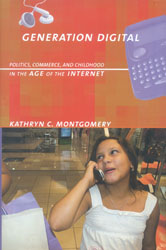
Generation Digital

Generation Digital:
Politics, Commerce & Childhood in the Age of the Internet
by Kathryn Montgomery
HQ784 .M3 M66 2007
New Book Island, 2nd floor

The cover of this book, as you may notice, has a picture of a young girl on a cell phone. The photo represents the theme of the book – how technology has changed growing up in the world and its effect on childhood. Montgomery, professor at American University and co-founder of the Center for Media Education, brings an interesting point of view to the table, as a media analyst/scholar, advocate and parent of a millenial. In Generation Digital, she explores how the media landscape has transformed childhood, resulting in techno-savvy youth that balance multitasking with a variety electronic devices look easy. The author also looks at the parallel policy debates that seek to protect these children from the dangers of the Internet. All of this comes into play when examining digital marketing and how it has evolved into what it is today. Packed with a historical perspective and tons of references, this is a great place to begin when researching the digital generation.

Posted in new stuff tuesdays | Tagged , , , , , , | Comments Off on New Stuff Tuesday – March 18

Keep Up With Science Research

Public Library of Science banner
The Public Library of Science is a non-profit site for keeping up with and freely sharing scientific and medical research. It is dedicated to open access to research articles, and also offers blogs, journal content alerts, and open access (no-fee) peer-reviewed journals in which researchers may publish their research. It could be a good place for students casting about for topics for research papers if they are interested in the sciences.

The site, less than 10 years old, recently added its 1,500th paper. Topics of recent articles include: Chimpanzee Autarky (Do chimps barter?) and Human and Chimpanzee Gene Expression Differences Replicated in Mice Fed Different Diets (Do mice eating different diets–human cafeteria food, McDonald’s fast food, mouse pellets, or lab chimp food–exhibit different gene expression?).

Recent blog topics include No Such Thing as a Free Lunch (or Gift or Sample), referring to the PLoS Medicine journal item The Cost of Pushing Pills: A New Estimate of Pharmaceutical Promotion Expenditures in the United States which argues that “the staggering amounts spent by drug companies on marketing” are not justified by their innovation in drug development, and Broiler Chicken Welfare Definitely Isn’t Pukka which discusses concerns about broiler chickens and the conditions in which they are raised.

PLoS encourages researchers to publish in its open access journals for maximum impact (since the articles are freely available all over the world), but there is a cost. UW-Madison is an institutional member of PLoS (see articles UW-Madison researchers have submitted since 2005).

Posted in around the world, tips for research | Tagged , , , , , , | Comments Off on Keep Up With Science Research

iGoogle, do you?

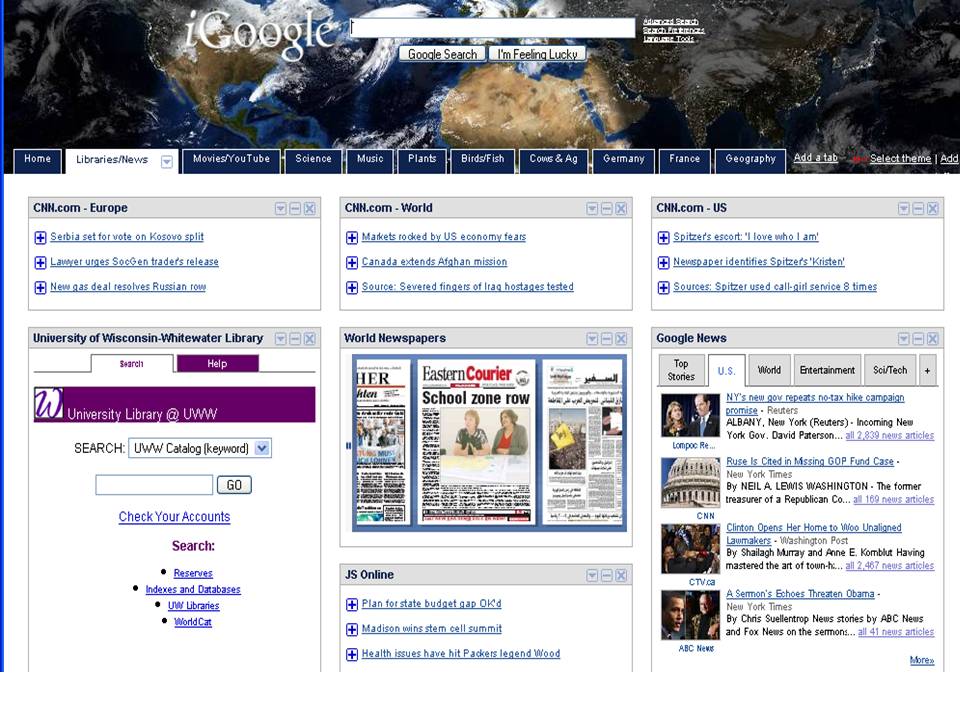
iGoogle has become a part of my daily life, and I can blame one of my coworkers. No, it’s not just searching Google I’m talking about! With a free Google account (you already have one if you use Gmail) you can personalize your online experience every time you go to Google:

  • Select a visual theme to decorate your page(s) and drag and drop individual sections to rearrange the page(s) however, and as often as, you’d like
  • Choose from thousands of Google Gadgets to add news, pictures, games, weather, words of the day, and more to your page(s)

My iGoogle tab for news
In my iGoogle I have quite a few tabs, each a page for a different category such as science news, general news (the one shown here), movies, plants, birds, France, etc. Each time I create and name a tab I populate it with a different banner and gadgets, all chosen from the many that are available (it’s easy–just click on “add stuff” and search for whatever interests you). On this image you can almost make out that your University Library has a gadget too! The gadgets I have here are (across the top:) CNN.com-Europe, CNN.com-World, CNN.com-US; (below the CNN gadgets row:) UWW Library’s gadget, world newspapers, and Google news; and (under world newspapers:) JS online from the Milwaukee Journal-Sentinel. If any of the news story headlines interests me, I can click on it to read it. If I want articles or books for more information I can search the Library’s catalog and article databases from the Library’s gadget. It’s that handy.

I am finding this to be a great way to keep up with news, and on other pages I have gadgets that help keep my blood pressure down (like the Georgia O’Keefe art print of the day), educate me (the science news gadgets are great for this!), or just entertain me (like the Eiffel Tower Mini Cam). Oh, and I can listen to the German word of the day.

Try it out!

Posted in around the library, around the world | Tagged , , , | 2 Comments

NIH-funded research & mandatory public access

The National Institutes of Health (NIH) ‘s public access submission policy will be mandatory as of April 7, 2008.

The NIH Public Access Policy implements Division G, Title II, Section 218 of PL 110-161 (Consolidated Appropriations Act, 2008). The law states:

The Director of the National Institutes of Health shall require that all investigators funded by the NIH submit or have submitted for them to the National Library of Medicine’s PubMed Central an electronic version of their final, peer-reviewed manuscripts upon acceptance for publication, to be made publicly available no later than 12 months after the official date of publication: Provided, That the NIH shall implement the public access policy in a manner consistent with copyright law.

Investigators whose research is funded by NIH in whole or in part must submit their final, peer-reviewed journal articles to PubMed Central, a free, online archive of full-text biomedical and life sciences journal articles. NIH has a list of journals that submit articles directly to PubMed Central on behalf of their authors.

More information is available online:

Government Printing Office logo

The University Library is a federal depository with many federal, state, local, and international documents on a variety of current and relevant issues available to you in print, microfiche, CD-ROM, and electronically. Come check out your government at the University Library!

Posted in around the world, info.gov | Tagged , , , , | Comments Off on NIH-funded research & mandatory public access