
OECD economic and development data

The Organisation for Economic Co-operation and Development’s goals are to support sustainable economic growth, boost employment, raise living standards, maintain financial stability, assist other countries’ economic development, and contribute to growth in world trade.
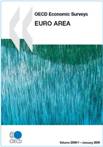
OECD economic survey coverIn support of its goals the OECD collects and publishes large amounts of economic data on countries. Many business and economics faculty and students already are familiar with the OECD economic surveys for countries and regions (copies in the 2nd-floor International Documents, OECD, collection at call no. OECD 10/). A title search in the Library Catalog for OECD economic surveys will display a list of the countries, and links are provided to see those that are available online.) But I never thought much about the “development” side of this organization’s name before.
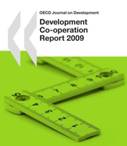
OECD development report coverThe OECD’s Development Assistance Committee publishes an annual Development Co-operation Report. (Recent reports have also been the first issue of the OECD Journal on Development. Print copies, including 2009, are in the Library’s 2nd-floor International Documents, OECD, collection at call no. OECD 43/3/ and earlier years are also online via the ABI/Inform database). This report provides “data on, and analysis of, the latest trends in international aid.”

It would be no surprise to read that it’s a tough climate for international aid right now. In fact, as it’s summed up in the 2009 report, “2008 was a year of crises: the food crisis, the fuel crisis and the financial crisis. These were all crises of globalisation; all were played out at the global level.” As countries grapple with these crises it is possible that the financial crisis may lead to an aid crisis as well. Furthermore, the 2009 report warns that increasing fragmentation (increasing numbers of donors and aid agencies) leads to inefficiencies, and a lack of focus and effectiveness. A recipient country may be dealing with numerous aid entities, and efforts may be wastefully duplicative, contradictory or even cancel each other out. Other issues exacerbated by this fragmentation are concentration of aid (which countries receive it) and control over how it is used.

There have been recent efforts to reform aid. Read the Paris Declaration on Aid Effectiveness (adopted 2005) and the Accra Agenda for Action (2008), which call for measures such as greater determination by recipient countries for how aid needs to be used to meet their goals.

Bottom Billion coverThere are, of course, many articles, videos, and books on aid also. For example, the 2007 OECD Development Co-operation Report mentioned a book called The bottom billion: why the poorest countries are failing and what can be done about it (3rd-floor Main Collection, HC 79.P6 C634 2007). A search of the library catalog for the subject keyword “economic assistance” would display a list of subjects containing this phrase, from which you could choose to find books and government documents such as African development: making sense of the issues and actors (3rd-floor Main Collection HC800 .M6775 2007), Commission for Africa: recommendations for a coherent strategy for Africa: hearing before the Committee on Foreign Relations, United States Senate, One Hundred Ninth Congress, first session, May 17, 2005 (2nd-floor US Documents, Y 4.F 76/2:S.HRG.109-203), and Economic recovery in Africa: the role of the IMF (2nd-floor Browsing VHS HC800 .E28 1999).

For assistance in finding these and related materials, please ask a librarian.

Government Printing Office logo

The University Library is a federal depository with many federal, state, local, and international documents on a variety of current and relevant issues available to you in print, microfiche, CD-ROM, and electronically. Come check out your government at the University Library!

Posted in around the library, around the world, info.gov | Tagged , , , , , , , , , , | Comments Off on OECD economic and development data

New Stuff Tuesday – June 23

College Drinking

College Drinking:
Reframing a Social Problem
By George Dowdall
HV5135 .D69 2009
New Book Island, 2nd floor

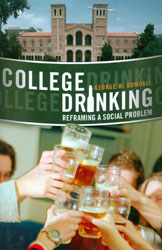
On days when the thermometer reaches into the nineties and you began to sweat the second you step outside, nothing cools you down like an ice-cold beverage. For some, that beverage may contain alcohol. Enjoying a beer isn’t necessarily a problem – it’s when that one beer turns into six and you’ve drank the night away. This week’s featured title tackles drinking, specifically with college students and the side effects that arise from use and abuse.

Dowdall, sociology professor at Saint Joseph’s University, goes after a serious issue that faces many, if not all, college campuses around the country: binge drinking. The author examines the progression of drinking in the college context over the past few decades, in which it has only ‘modestly’ increased. He then presents the reasons for which college students drink, from peer pressure and social acceptance to rites of passage. Dowdall also looks at the effects of drinking – the health risks associated with high-risk drinking, as well as alcohol-related criminal activity. The author doesn’t just lie out the facts – he also provides solutions to correcting the problem. If you’re writing a research paper about the drinking habits of college students, you’ll definitely want to check this one out.

Posted in new stuff tuesdays | Tagged , , , , , , | Comments Off on New Stuff Tuesday – June 23

Discontinued: STAT-USA

The Library will not continue to subscribe to STAT-USA. Our current subscription runs through the end of this month (June). The resource, produced by the US Department of Commerce, provides market research and analysis on international business opportunities.

If you have relied on information from STAT-USA in the past, don’t worry – the Library has a solution. Many of the reports found in STAT-USA are available through Export.gov in their Market Research Library. You can obtain a free account and access as students and researchers. If you’re just looking for the Country Commercial Guides, which explain how to do business in a particular country, those are available without registration.

And you should also not forget Passport Reference & Markets (formerly Global Market Information Database) for another source of excellent international business information.

Posted in online @ the library | Tagged , , , | 2 Comments

And they’re off… iPhones, Kindles, Audiobooks, Print

The Chronicle of Higher Education recently provided a university dean’s perspective on comparing different formats (paperback, Kindle, iPhone, and audiobook) for reading a novel. Those of us who haven’t experimented with these alternatives might find the article illuminating:

Kirschner, A. (2009). Reading Dickens four ways: How ‘Little Dorrit’ fares in multiple text formats. Chronicle of Higher Education, Section: The Chronicle Review, 55(39), B16.

Posted in around the world | Tagged , , , , , , , , | Comments Off on And they’re off… iPhones, Kindles, Audiobooks, Print

Mind Your Intercultural P’s & Q’s

The CBS News World Watch blog entry “Some Israelis Insulted by Obama Picture” on June 9th showed a photo of President Obama with his feet up on the Oval Office desk while talking on the phone with Israeli Prime Minister Benjamin Netanyahu. What’s this about?

“It is considered an insult in the Arab world to show the sole of your shoe to someone. It is not a Jewish custom necessarily, but Israel feels enough a part of the Middle East after 60 years to be insulted too.”

clip art showing diversityI hope most people did not see this as an insult, since the Prime Minister was not in the same room. But it is a reminder that it’s a good idea to do a little homework before interacting with people from other cultures.

The University’s Communication Department offers a course called Cross Cultural Communication (it can count toward satisfying general education and diversity requirements), and the Library has some resources that can help too:

  • Culture and Customs volumes from Greenwood Press cover everything from a country’s geography and history to cuisine, arts and entertainment. Search for culture and customs as a title in the Library catalog to find the available countries.
  • A Library catalog “keyword” search for (guidebooks or travel) and ___ (fill in the name of a country) would find titles such as The rough guide to Japan (3rd-floor Main Collection, DS811 .D63 2008)
  • A Library catalog “keyword” search for (etiquette or “national characteristics” or customs) and ___ (fill in the name of a country) would find titles including France (A quick guide to customs & etiquette) (3rd-floor Main Collection, DC33.7 .T598 2003) and Au contraire!: Figuring out the French (3rd-floor Main Collection, DC34 .A77 2001)
  • Consult the 2nd-floor Reference sets CultureGrams (Reference GT150 .C85 2007), Countries and their Cultures (Reference GN307 .C68 2001), and Global Etiquette Guide… (Reference BJ1838 .F) for the country that interests you.

Would you like some assistance finding these and other materials? Ask a Librarian (in person, or via phone, email or chat) and/or consult the Library guide to “Locating Intercultural Communication Information”.

Posted in around the library, around the world | Tagged , , , , , | Comments Off on Mind Your Intercultural P’s & Q’s

Art History – best research tools

Since Google pretty much dominates the search engine world, it seems to set the gold standard for web searching. A recent blog entry mentioned the article that compared the scholarliness of Google Scholar content vs. library database content. “How Scholarly Is Google Scholar? A Comparison to Library Databases” (College and Research Libraries, May 2009) concluded that Google Scholar offers a higher percentage of scholarly material than do library databases.

Art History

But a Master’s thesis by Hannah M. Noll at Univ. of North Carolina at Chapel Hill found a different sort of result. She tested Google Scholar against three library databases: Bibliography of the History of Art, Art Full Text/Art Index Retrospective and Arts & Humanities Citation Index. By using a set of 472 articles, she tested which of the databases retrieved the most number of articles.

I won’t give away the punch line. But you can find out for yourself how well the library databases fared in Noll’s thesis, Where Google Scholar Stands on Art: An Evaluation of Content Coverage in Online Databases.

By the way, the Library subscribes to the Arts & Humanities Citation Index and Art Full Text databases.

Posted in around the library, online @ the library | Tagged , , , , , | Comments Off on Art History – best research tools

New Stuff Tuesday – June 16

Manage the Media

Manage the Media:
(Don’t Let the Media Manage You)
By William Holstein
HD59.6 .U6 H653 2008
New Book Island, 2nd floor

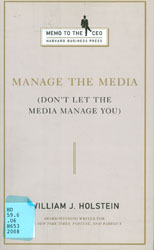
A reputation, whether individual or group, is intangible and can pave the way to success or failure. Public perception of a company has become fragile with the proliferation of the media and technology. They’re not only competing with the reporters and newspapers in the traditional realm, they’re also defending their names against everyone from bloggers to Amazon product reviewers. One misstep could mean finding yourself in a very deep hole with no way out. So what is an organization to do? This week’s featured title details the challenges of today’s media and how to handle them.

Holstein, a veteran business writer for the New York Times, Fortune and Barron’s, among others, has written a short (just over one hundred pages), no-nonsense book about dealing with potential communications pitfalls. Directed at CEOs, the author explains the importance of communication and public relations, complete with examples of both good and bad PR management. The emergence of the Internet (as well as Web 2.0 and social networking tools) has enabled individual consumers to rally against the big, bad corporation. Holstein provides strategies for putting corporate communication first, shaping the message and ensuring that the company’s image stays intact.

Posted in new stuff tuesdays | Tagged , , , , , , | Comments Off on New Stuff Tuesday – June 16

It’s Flag Day

In case you weren’t aware, June 14th is Flag Day in the United States. This date in June was probably chosen because on June 14th in 1777, the Continental Congress approved a resolution that established the U. S. flag’s design (“thirteen stripes of alternate red and white, with a union of thirteen stars of white in a blue field….”).

It was almost a century later when June 14th started being celebrated as flag day in some regions of the country. One of the people who promoted Flag Day was a school teacher from Waubeka, Wisconsin, by the name of Bernard J. Cigrand. He reportedly spent years trying to get Congress to declare Flag Day a national holiday.  Waubeka, if you haven’t heard of it, is about 35 miles north of Milwaukee.

Want to learn more? Check out the book, Flag Day: Its History, Origin, and Celebration as Related in Song and Story in the library’s main collection on the 3rd floor, call #JK1761 .F6 1979.

The Library of Congress has some information and photos about this day at Today in History: June 14, and the Wisconsin State Legislative Reference Bureau Web page, Memorial Day and Flag Day, claims that Wisconsin is where the idea of celebrating Flag Day first originated. This is contradicted on the Origins of Flag Day page from the United States Department of Veterans Affairs, but as a Wisconsinite myself, I think I’ll believe the Legislative Bureau’s claim.

Government Printing Office logo

The University Library is a federal depository with many federal, state, local, and international documents on a variety of current and relevant issues available to you in print, microfiche, CD-ROM, and electronically. Come check out your government at the University Library!

Posted in info.gov | Tagged , | 1 Comment

Switched over?

I turned on my TV this morning to find only one channel still working, Milwaukee Public Television-ch. 10, but it had a huge banner running across it saying that as of 9 AM today (June 12, 2009) the signal would be disconnected.  I knew it was coming but it still took me by surprise. 

I did a little searching to find the following article from USA Today.  Interesting stats.  Check it out.

 http://search.ebscohost.com/login.aspxdirect=true&db=aph&AN=J0E171778254009&site=ehost-live

Were you ready for the switch?  Let me know how your experience was with the switch from analog to digital.  I intend to still use my TV for video games and watching movies.  Hope you are seeing more than snow on your TV.  Well remember to rescan your TV or better yet come to the library and get a book, movie or game.

For more information, go to www.dtv.gov call the FCC at 888-CALL-FCC

Posted in around the world, info.gov, online @ the library | Tagged , , , , , , | 1 Comment

The Global Struggle

I feel like the majority of what I blog about is the economy and trying to come up with synonyms for recession. I guess that as the business librarian, it is expected of me.

America is not alone in the current economic hardship – the rise of globalization and the ever-connected societies of the world have the entire world feeling the pinch. However, some countries are feeling it worse than others. So just how is Italy or Venezuela or [insert favorite country here] dealing with the slowdown?

In response to this question, Euromonitor has published a series of Global Risks and Vulnerabilities briefings as part of Passport Reference & Markets (formerly known as Global Market Information Database). These reports address external sector shocks, real estate, government finance, energy, socio-political shocks and environmental shocks as part of a measure of the country’s economic health.

To get to the documents, click on the Countries link in the main navigational bar and the Country Briefings are located in the upper-right corner.

Posted in around the world, online @ the library | Tagged , , , , , | Comments Off on The Global Struggle