Tag Archives: UW-Whitewater

The Upham Greenhouse

Ali Locascio, front, a business major from Loves Park, Illinois, and Richard Tazelaar visit the campus greenhouse on April 10, 2023. UW-Whitewater Sustainability offered tours of the greenhouse to share the plant varieties there and the opportunities to get involved. Sustainability’s Earth Month activities continue through April: https://www.uww.edu/sustainability/earth-month-2023. (UW-Whitewater photo/Craig Schreiner)

Have you ever been to the Greenhouse on campus? Did you even know that we have a greenhouse on campus? Don’t worry… you are not alone.

The Upham Greenhouse is home to an array of plants, student orgs, and of course, the Sustainability Office. Students Allied for a Greener Earth (S.A.G.E.), Garden Club, and several others use the Greenhouse as their weekly meeting space, but our office also hosts many events down there! Plant workshops, tours, and special events have all been hosted in the space over the years.

Originally built in 1981, the Upham Greenhouse was meant to serve the Biological Sciences Department. While the Biology Department oversaw the greenhouse, the department curated a botanical collection of various exotic plants found in both desert and rainforest environments– and we still have most of the collection today! The collection was kept up by biology majors and volunteers until eventually the space became used for storage.

Eventually, the Sustainability Office started to overtake the space– we moved in, renovated, cleaned, and poured blood, sweat, and tears into the building, turning the greenhouse into the community space that it is now!

A number of student projects are conducted in the greenhouse in partnership with our office. This ranges from a graduate psychology student researching the effects of being surrounded by houseplants on mental health, an art student who grows and dries flowers for paints, and even a vermicomposting system being run by a student organization (S.A.G.E.).

Campus greenhouse manager Tress Dorfler, a geography major from Mundelein, Illinois, delights in one of the plant varieties as she waters plants in the greenhouse. Students returned to classes at the start of the spring semester on Monday, Jan. 26, 2026. (UW-Whitewater photo/Craig Schreiner)

There are actually three greenhouses in use:

  • Greenhouse 1 is used for our annual plant sale, when we sell hundreds of house plants, vegetables, and native prairie plants from our campus nature preserve. “GH1” also has table space that student organizations have borrowed, as well as student research projects (above).
  • Greenhouse 2 grows our houseplants. We provide plants for many events that we participate in, such as UC Live’s Succulent Workshop. Spider plants, Aloe, Kalanchoe, and succulent plants all live in Greenhouse 2.
  • Greenhouse 3 is where we keep the botanical collection that was started by the Biological Sciences Department! Cacti, trees, succulents, and more make up the 100+ different species of plants kept in the botanical collection.

The Upham Greenhouse has become the de-facto campus location for our office, providing an opportunity for us to better connect with students, partner with student organizations, and host events for the student body.

The Greenhouse is open for enjoyment whenever Upham Hall is open. As long as everyone follows a few guidelines:

  • Please do not touch, move, pick, or take any plants from the greenhouse. Our interns work very hard to keep our plants happy and healthy for plant sales and events! Plus, some of our plants are very sensitive and/or very sharp (from experience… not worth it to touch the spikes).
  • Since the greenhouse has become the Sustainability Office’s main workspace, please pick up after yourself and help keep the space clean.
  • Finally, we try our best to save energy here, so please turn off any lights that you turned on and close doors behind you to keep our temperatures regulated.

After many renovations, deep cleanings, and maintenance repairs, the greenhouse has become a part of the campus community, and provides a home to many different plants. During your time at UW-Whitewater, we hope you get a chance to enjoy the Upham Greenhouse, whether it be through events, student org meetings, or just exploring on your own time. 

Large numbers of students answered the call to “turn trash into treasure” by making terrariums in glass jars with plants, mosses and soil at the campus greenhouse on April 10, 2023. Students also toured the greenhouse to view the plant varieties there and learn about opportunities to get involved. Sustainability’s Earth Month activities continue through April: https://www.uww.edu/sustainability/earth-month-2023. (UW-Whitewater photo/Craig Schreiner)

Directions to the Upham Greenhouse:

  1. Go into the main entrance of Upham Hall and enter the main lobby.
  2. Turn down the Physics Department hallway (Long hallway to the right of the lobby) and walk to the end of the hallway.
  3. Next to the Upham Recycling Nook and a bulletin board of flyers is the door for the greenhouse

Summer Stream Monitoring Continues

Written by Ashley Roscoe

Happy Summer! My name is Ashley, and I am the Stream Monitoring Coordinator at the UW-Whitewater Sustainability Office. I took over the monitoring program last fall, and have enjoyed every minute of it! Our program has run under the Water Action Volunteers program since 2013, in partnership with the Wisconsin Department of Natural Resources. Normally, we will have volunteers come out to sessions to learn about the program and participate in conducting tests. As soon as the University switched to remote learning due to COVID, we suspended volunteer participation. I have still been going out three times a month (each stream gets monitoring once a month), sometimes with the help of garden and greenhouse manager, Cam.

Cam emptying the net full of pebbles and critters. This is used to conduct the biotic index portion of the Stream Monitoring program.

A new addition to our program has been nutrient monitoring! While we are out at our three creeks (Spring Brook at Willow Brook Golf Course, Bluff Creek at Hwy P, and Whitewater Creek at Fremont St Bridge), we now collect a sample of water. We mix in a small amount of Sulfuric Acid, and then send the sample to the State of Wisconsin Hygiene Lab. From this water sample, the amount of nutrients are able to be calculated. This data is used to determine trends in the waterway, and are able to establish a baseline nutrient level.

Plain Pocketbook Mussel (Lampsilis Cardium)

Along with baseline monitoring and nutrient monitoring, we also participate in the Mussel Monitoring Program through the Wisconsin Department of Natural Resources. We mainly search for mussels in Whitewater Creek. Over half of the 52 mussel species in Wisconsin need conservation assistance or we need more information on the location of the species. Through this program, we locate mussels, take photos of the mussels, determine species located, take counts of numbers per species, and then we report these mussels to the Wisconsin Department of Natural Resources. This program helps track mussel populations throughout the state! Mussel populations in Wisconsin were decimated in the late 19th and early 20th centuries due to the button industry. This program helps ensure populations are staying at consistent, healthy numbers. 

To learn more about the stream monitoring program, watch our youtube video that outlines more of the program! You can also visit https://wateractionvolunteers.org or https://dnr.wi.gov/topic/SurfaceWater/monitor.html for more information! If you are interested in volunteering with us for stream monitoring, contact the Sustainability Office at sustainability@uww.edu

Gearing Up for Garden Season

As we head into the sixth season at the Campus Garden we reflect back on our mission to serve the Whitewater Food Pantry with fresh, organic produce, as well as to educate the campus and community about the benefits of organic gardening. A majority of the produce grown gets donated weekly to the local food pantry. To date we have donated over 5,000 pounds of produce; with roughly 1,400 pounds donated last year and 1,700 pounds donated in 2016. By adding a small orchard with a wide variety of fruit trees, we hope to reach the goal of donating 2,000 pounds of fresh produce per year.

A variety of fruit trees were added to the Campus Garden during Earth Week events with Honors Program students in 2016.

Updates from the Garden Manager

As the weather gets warmer and the spring season approaches, activity in the Upham Greenhouse and the Campus Garden is rapidly increasing. The seedlings planted in early March (onions, leeks, kale, cauliflower, and broccoli) are craving the outdoors, awaiting the early planting sessions. The daily indoor watering and care of tomatoes, peppers, beets, chard, herbs, and brassicas will soon be replaced by the natural water cycle and some irrigation in the garden. Soon, we will be planting the seeds of cucurbits (cucumbers, melons, and squash). After some bed prepping, edging, and maintenance, all the seedlings will be ready to be planted throughout the month of May. This is a yearly routine with a strict schedule.

Though the schedule is demanding, we are introducing some new additions to the garden with inspiration from permaculture design. Our orchard is becoming much vaster with a wide variety of fruit trees and exotic shrubs. From native elderberry to plum trees, the diversity within the Campus Garden is growing each season.

This time of year, the amount of work needed outdoors is accumulating. We aim to plant crops outdoors in early May, and the full planting will take place after the last average frost date in late May.  Volunteer hours continue from May through late October or early November, depending on first frost.

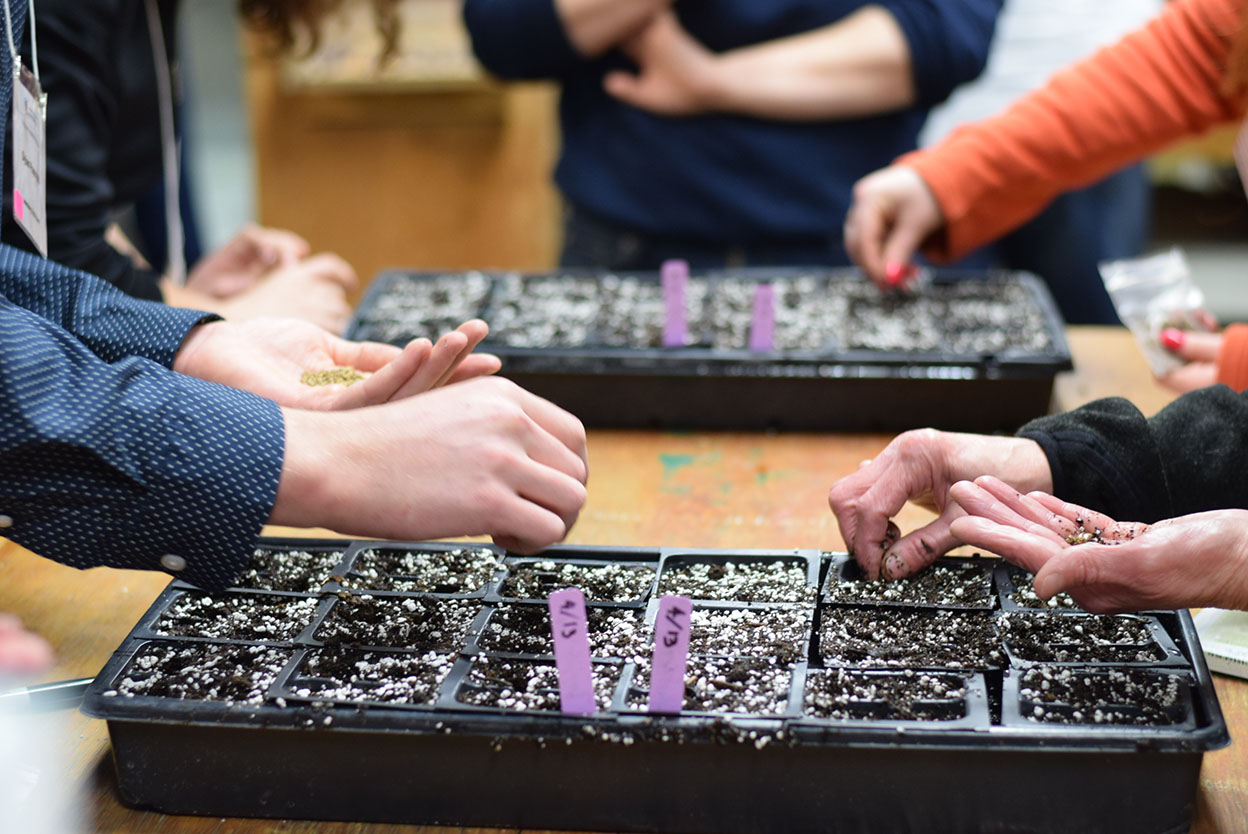
Visiting Honors Program students planting beet seeds.

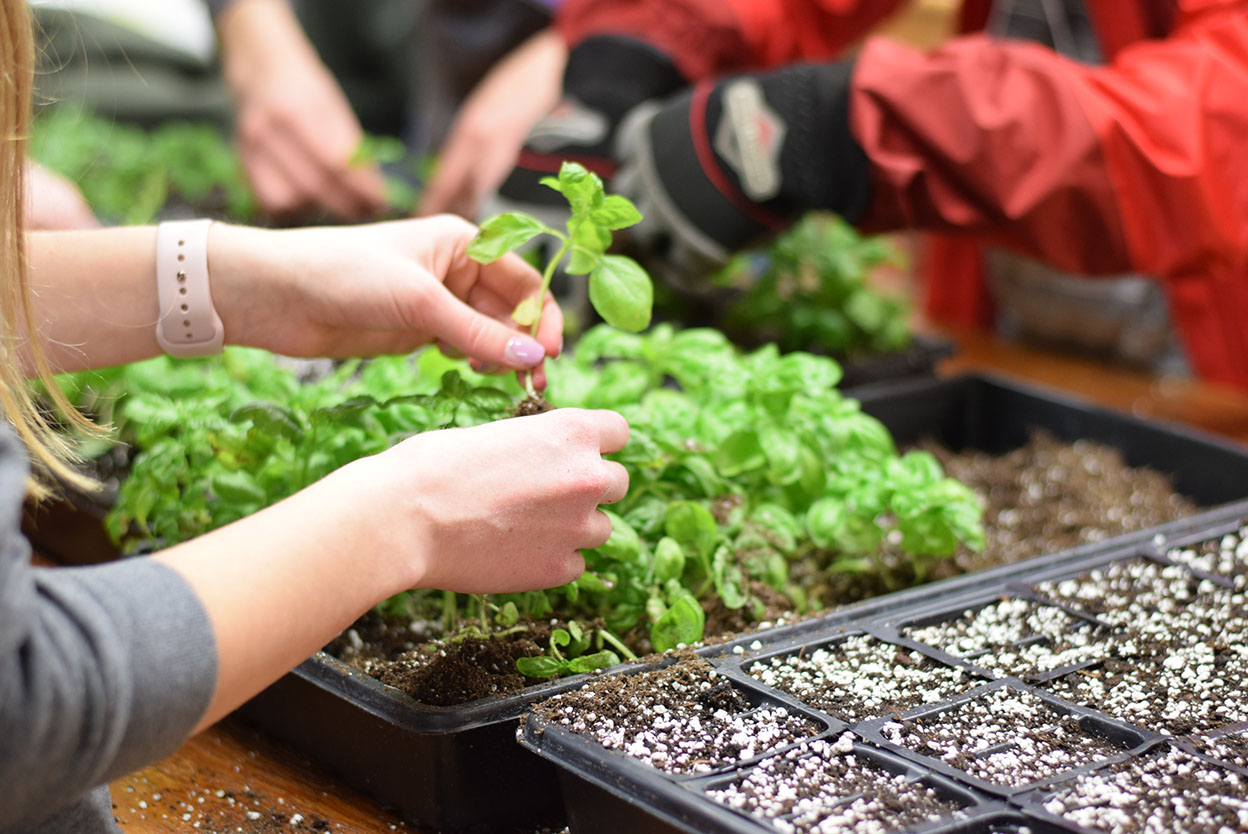
Honors students helping transplant basil.

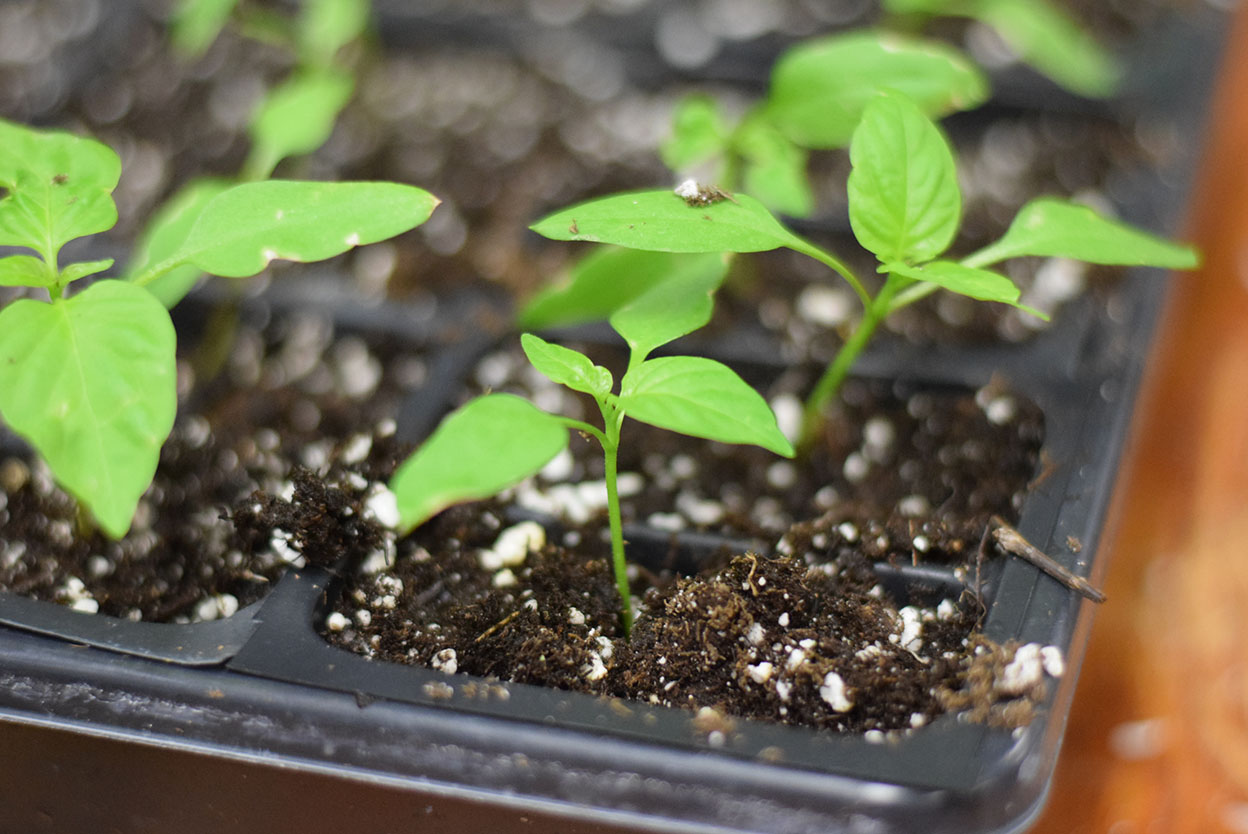
Pepper seedlings growing strong in the Upham Greenhouse.

How to Get Involved

The best way for you to support the Campus Garden is to volunteer your time and energy by joining us for the work needed to keep up with the garden. Gardening tasks that regularly need our attention include bed prep/turning, weeding, watering, seeding/planting, harvesting, transplanting, cleaning/sanitizing, and more. Without the helping hands of our volunteers, we would not have the time available to maintain the garden and keep it going, so any and all help is greatly appreciated!

All skill levels are welcome.  Tools and gloves are provided, but we recommend any experienced gardener to bring your tools you are most comfortable using (and maybe show us how you do it)!  Volunteer hours are tracked for reporting to a number of different organizations that require them.

Upcoming Events

Join us at the Campus Garden, located between the Moraine Bookstore and Ambrose Health Center on Starin Road (764 W. Starin Road, Whitewater, WI 53190).

Planting Party

  • Lend a hand planing tomatoes, peppers, cucumbers, melons, squash, peas, beans, radishes, greens, carrots, and herbs! Check out our Facebook event for more information.
  • Tuesday, May 29 from 3 – 7 PM

Volunteer Sessions (May)

  • Tuesdays: 5:00 PM – 7:00 PM
  • Thursdays:  2:00 PM – 4:00 PM
  • Fridays:  10:00 AM – 12:00 PM

Volunteer Sessions (June – August)

  • Mondays 3-6 PM
  • Tuesdays 3-6 PM (Harvesting!)
  • Wednesdays 9-11 AM
  • Thursdays 10 AM-1 PM

UWW Campus Garden on a sunny August day.