Tag Archives: sustainability

The Upham Greenhouse

Ali Locascio, front, a business major from Loves Park, Illinois, and Richard Tazelaar visit the campus greenhouse on April 10, 2023. UW-Whitewater Sustainability offered tours of the greenhouse to share the plant varieties there and the opportunities to get involved. Sustainability’s Earth Month activities continue through April: https://www.uww.edu/sustainability/earth-month-2023. (UW-Whitewater photo/Craig Schreiner)

Have you ever been to the Greenhouse on campus? Did you even know that we have a greenhouse on campus? Don’t worry… you are not alone.

The Upham Greenhouse is home to an array of plants, student orgs, and of course, the Sustainability Office. Students Allied for a Greener Earth (S.A.G.E.), Garden Club, and several others use the Greenhouse as their weekly meeting space, but our office also hosts many events down there! Plant workshops, tours, and special events have all been hosted in the space over the years.

Originally built in 1981, the Upham Greenhouse was meant to serve the Biological Sciences Department. While the Biology Department oversaw the greenhouse, the department curated a botanical collection of various exotic plants found in both desert and rainforest environments– and we still have most of the collection today! The collection was kept up by biology majors and volunteers until eventually the space became used for storage.

Eventually, the Sustainability Office started to overtake the space– we moved in, renovated, cleaned, and poured blood, sweat, and tears into the building, turning the greenhouse into the community space that it is now!

A number of student projects are conducted in the greenhouse in partnership with our office. This ranges from a graduate psychology student researching the effects of being surrounded by houseplants on mental health, an art student who grows and dries flowers for paints, and even a vermicomposting system being run by a student organization (S.A.G.E.).

Campus greenhouse manager Tress Dorfler, a geography major from Mundelein, Illinois, delights in one of the plant varieties as she waters plants in the greenhouse. Students returned to classes at the start of the spring semester on Monday, Jan. 26, 2026. (UW-Whitewater photo/Craig Schreiner)

There are actually three greenhouses in use:

  • Greenhouse 1 is used for our annual plant sale, when we sell hundreds of house plants, vegetables, and native prairie plants from our campus nature preserve. “GH1” also has table space that student organizations have borrowed, as well as student research projects (above).
  • Greenhouse 2 grows our houseplants. We provide plants for many events that we participate in, such as UC Live’s Succulent Workshop. Spider plants, Aloe, Kalanchoe, and succulent plants all live in Greenhouse 2.
  • Greenhouse 3 is where we keep the botanical collection that was started by the Biological Sciences Department! Cacti, trees, succulents, and more make up the 100+ different species of plants kept in the botanical collection.

The Upham Greenhouse has become the de-facto campus location for our office, providing an opportunity for us to better connect with students, partner with student organizations, and host events for the student body.

The Greenhouse is open for enjoyment whenever Upham Hall is open. As long as everyone follows a few guidelines:

  • Please do not touch, move, pick, or take any plants from the greenhouse. Our interns work very hard to keep our plants happy and healthy for plant sales and events! Plus, some of our plants are very sensitive and/or very sharp (from experience… not worth it to touch the spikes).
  • Since the greenhouse has become the Sustainability Office’s main workspace, please pick up after yourself and help keep the space clean.
  • Finally, we try our best to save energy here, so please turn off any lights that you turned on and close doors behind you to keep our temperatures regulated.

After many renovations, deep cleanings, and maintenance repairs, the greenhouse has become a part of the campus community, and provides a home to many different plants. During your time at UW-Whitewater, we hope you get a chance to enjoy the Upham Greenhouse, whether it be through events, student org meetings, or just exploring on your own time. 

Large numbers of students answered the call to “turn trash into treasure” by making terrariums in glass jars with plants, mosses and soil at the campus greenhouse on April 10, 2023. Students also toured the greenhouse to view the plant varieties there and learn about opportunities to get involved. Sustainability’s Earth Month activities continue through April: https://www.uww.edu/sustainability/earth-month-2023. (UW-Whitewater photo/Craig Schreiner)

Directions to the Upham Greenhouse:

  1. Go into the main entrance of Upham Hall and enter the main lobby.
  2. Turn down the Physics Department hallway (Long hallway to the right of the lobby) and walk to the end of the hallway.
  3. Next to the Upham Recycling Nook and a bulletin board of flyers is the door for the greenhouse

4 Ways to Eat Local

Eating local is beneficial to both the environment and our health. It’s estimated that U.S. meals have traveled 1,500 miles from farm to plate. These lengthy transportation times require crops to be harvested prematurely and result in lower nutritional content that continues to decline before being consumed. Local food travels shorter distances, which also means less fuel and fewer greenhouse gases.

Wisconsin’s water, soil, and climate contribute to it being ranking as one of the nation’s leading agricultural states. Here in south-central Wisconsin, we have a number of options available to access fresh, local foods during our growing season.  Eating locally can significantly reduce your individual carbon footprint by avoiding the travel, but it also has health benefits because organic produce tends to be more affordable when purchased locally and directly from producers.

1. Shop at a food co-op

Co-ops generally seek local, organic, quality foods and dry goods. Rather than being privately or investor-owned, food cooperatives are owned and governed by the community.  These grocery stores are open for all to shop but also welcome shoppers to join as member-owners, allowing them to vote on decisions regarding the operations of the co-op. To find a co-op near you, visit localharvest.org.  Currently, the closest co-op in operating to Whitewater is Basics Cooperative, but there is there’s a co-op coming to Whitewater hopefully soon!

Whitewater Grocery Co. serves to nourish and educate the community while offering local foods, natural choices, and gourmet options. Planning efforts for the Whitewater GroCo began in 2016 and they anticipate opening in the next few years once they reach their target ownership goal of 1,000. For membership options and more information visit whitewatergrocery.co.

The  408th owner of the Whitewater Grocery Co. (Source: Whitewater Grocery Co.)

2. Shop at local farmers markets

Whether you’re shopping for produce, honey, flowers, meats, products from the farmers market are minimally processed and more humane than conventional agriculture. You’re also able to meet farmers and artisans directly to learn about how and where your food is made. While farmers markets usually offer produce, some also have various forms of entertainment including music, food trucks, art, crafts, and other products. Going to local markets is a fun thing to do with family, friends, or to meet new people within the community. Check out localharvest.org to find farmers markets in your area.

Whitewater has two weekly farmers markets available throughout the growing season! From May through October, the Whitewater City Market is held at the Historic Train Depot (301 W. Whitewater St.) on Tuesdays from 4-7 PM. The Whitewater Farmer’s Market is held on Saturdays from 8 AM-12 PM at the True Value (1415 W. Main Street).

Clint from Regenerative Roots selling produce at the Whitewater City Market (Source: Whitewater City Market)

3. Join a CSA

Community supported agriculture (CSA) connects consumers to local food directly from farmers. By purchasing an annual “share,” members are provided with fresh, seasonal produce and other specialty products. Product offerings and delivery options vary by CSA.  Visit localharvest.org to find a CSA near you.

UW-Whitewater is a host site for Wholesome Harvest CSA, a family farm located in Fort Atkinson, WI that offers a variety of membership options for their products including produce, meats, and eggs with weekly deliveries to the University Center for its members.  They anticipate achieving organic certification in the next year or so and have used organic methods for a number of years.  Additionally, the city of Whitewater is served by Regenerative Roots, a Certified Organic farm located near Jefferson, WI that delivers to The SweetSpot Cafe.  As an added bonus, CSAs are typically looking for summer help and can be a great job for students to learn more about farming and gardening produce!

Fresh tomatoes growing at Wholesome Harvest CSA. (Source: Wholesome Harvest Farm)

4. Start your own garden

Growing your vegetables is as local as it gets! If you don’t have the space or aren’t ready to commit to a traditional garden bed, container gardening is a manageable alternative and easy way to get started. Joining a community garden is another option, allowing you to rent a garden plot for the season. This also gives you the opportunity to connect with fellow gardeners to share tips and tricks! Attending volunteer sessions at the UW-Whitewater Campus Garden is another option to learn about gardening maintenance first hand.

Whitewater Community Garden (1201 Innovation Drive) has 30 plots available to the public with access to water and tools included in the rental fee. If you’re not in the Whitewater area, you can search for local community gardens at communitygarden.org.

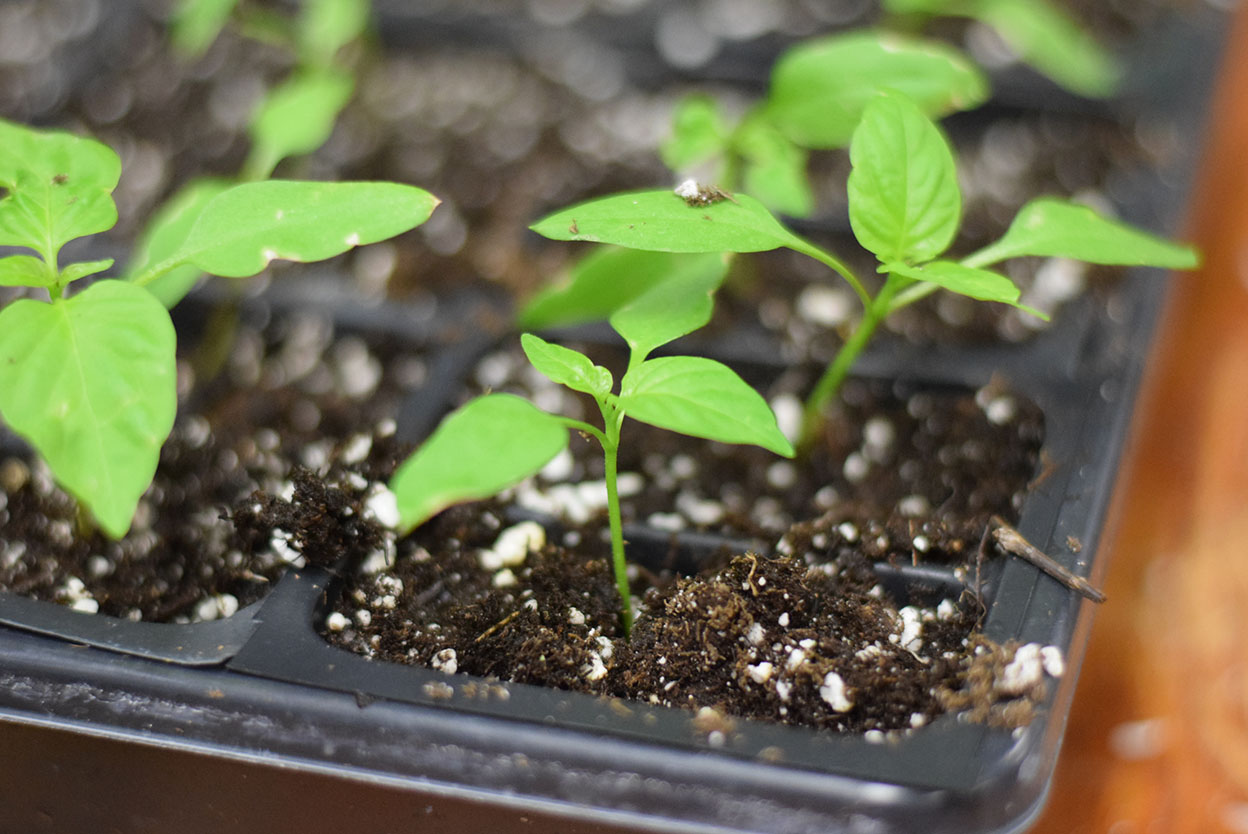
Pepper seedlings planted at the Campus Garden. (Source: UW-Whitewater/Craig Schreiner)


Gearing Up for Garden Season

As we head into the sixth season at the Campus Garden we reflect back on our mission to serve the Whitewater Food Pantry with fresh, organic produce, as well as to educate the campus and community about the benefits of organic gardening. A majority of the produce grown gets donated weekly to the local food pantry. To date we have donated over 5,000 pounds of produce; with roughly 1,400 pounds donated last year and 1,700 pounds donated in 2016. By adding a small orchard with a wide variety of fruit trees, we hope to reach the goal of donating 2,000 pounds of fresh produce per year.

A variety of fruit trees were added to the Campus Garden during Earth Week events with Honors Program students in 2016.

Updates from the Garden Manager

As the weather gets warmer and the spring season approaches, activity in the Upham Greenhouse and the Campus Garden is rapidly increasing. The seedlings planted in early March (onions, leeks, kale, cauliflower, and broccoli) are craving the outdoors, awaiting the early planting sessions. The daily indoor watering and care of tomatoes, peppers, beets, chard, herbs, and brassicas will soon be replaced by the natural water cycle and some irrigation in the garden. Soon, we will be planting the seeds of cucurbits (cucumbers, melons, and squash). After some bed prepping, edging, and maintenance, all the seedlings will be ready to be planted throughout the month of May. This is a yearly routine with a strict schedule.

Though the schedule is demanding, we are introducing some new additions to the garden with inspiration from permaculture design. Our orchard is becoming much vaster with a wide variety of fruit trees and exotic shrubs. From native elderberry to plum trees, the diversity within the Campus Garden is growing each season.

This time of year, the amount of work needed outdoors is accumulating. We aim to plant crops outdoors in early May, and the full planting will take place after the last average frost date in late May.  Volunteer hours continue from May through late October or early November, depending on first frost.

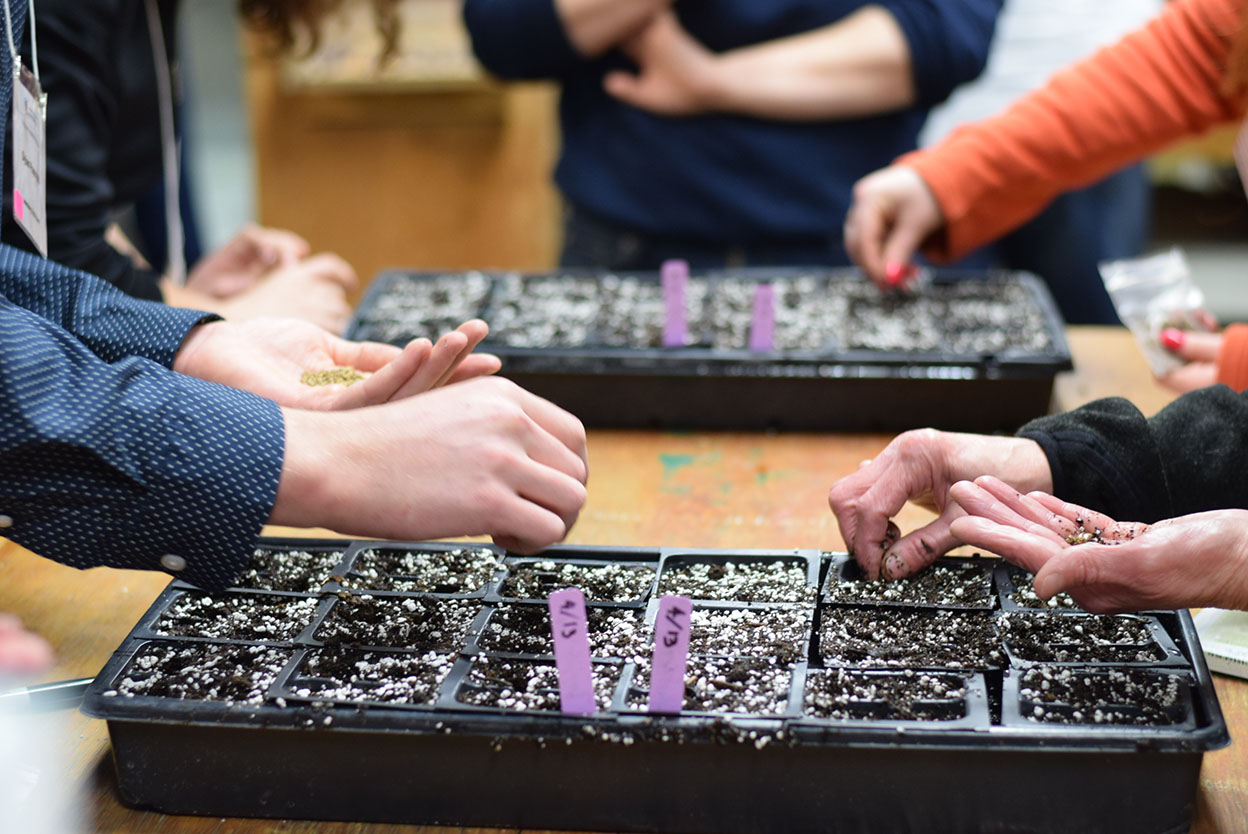
Visiting Honors Program students planting beet seeds.

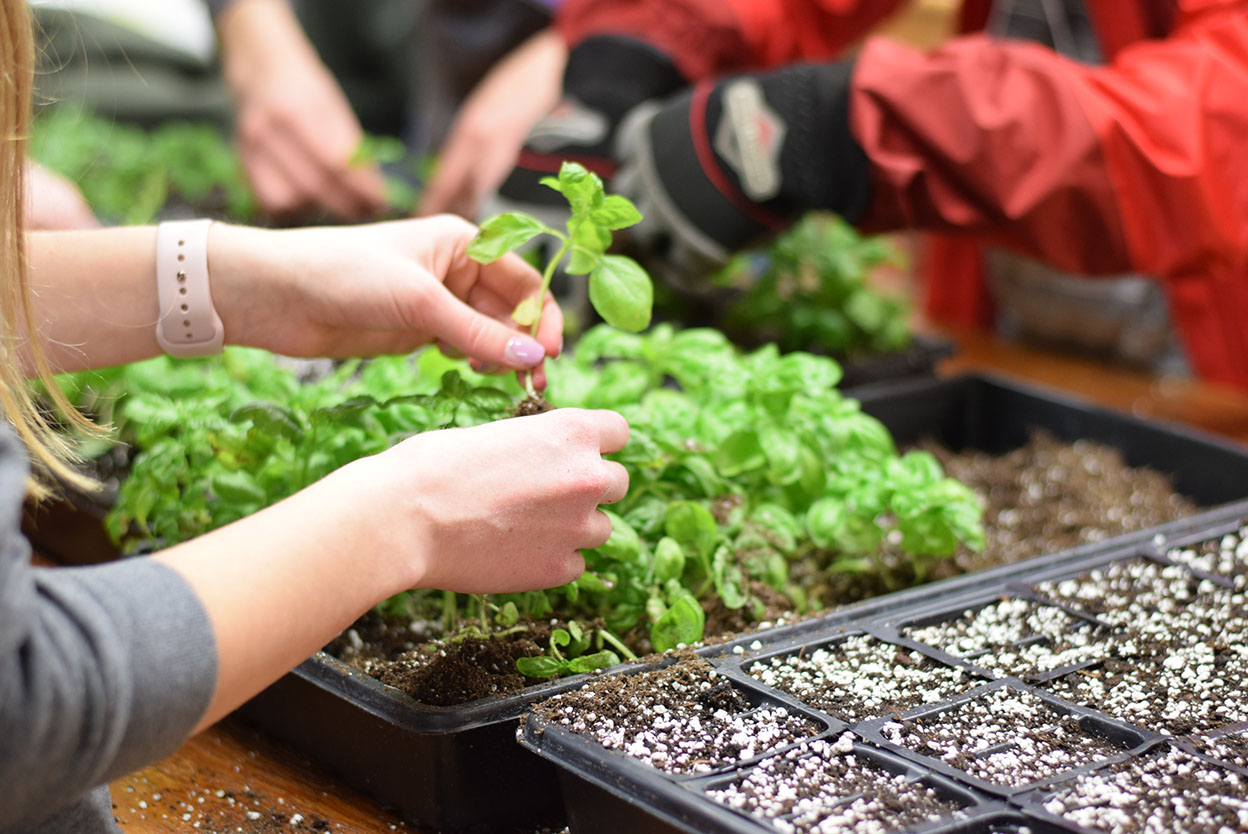
Honors students helping transplant basil.

Pepper seedlings growing strong in the Upham Greenhouse.

How to Get Involved

The best way for you to support the Campus Garden is to volunteer your time and energy by joining us for the work needed to keep up with the garden. Gardening tasks that regularly need our attention include bed prep/turning, weeding, watering, seeding/planting, harvesting, transplanting, cleaning/sanitizing, and more. Without the helping hands of our volunteers, we would not have the time available to maintain the garden and keep it going, so any and all help is greatly appreciated!

All skill levels are welcome.  Tools and gloves are provided, but we recommend any experienced gardener to bring your tools you are most comfortable using (and maybe show us how you do it)!  Volunteer hours are tracked for reporting to a number of different organizations that require them.

Upcoming Events

Join us at the Campus Garden, located between the Moraine Bookstore and Ambrose Health Center on Starin Road (764 W. Starin Road, Whitewater, WI 53190).

Planting Party

  • Lend a hand planing tomatoes, peppers, cucumbers, melons, squash, peas, beans, radishes, greens, carrots, and herbs! Check out our Facebook event for more information.
  • Tuesday, May 29 from 3 – 7 PM

Volunteer Sessions (May)

  • Tuesdays: 5:00 PM – 7:00 PM
  • Thursdays:  2:00 PM – 4:00 PM
  • Fridays:  10:00 AM – 12:00 PM

Volunteer Sessions (June – August)

  • Mondays 3-6 PM
  • Tuesdays 3-6 PM (Harvesting!)
  • Wednesdays 9-11 AM
  • Thursdays 10 AM-1 PM

UWW Campus Garden on a sunny August day.

Sustainability Coordinator

Hello UW-Whitewater Community!

My name is Wesley Enterline and I am the first Sustainability Coordinator for our campus.  I have been a UW-W student for seven years total and for the last two years as the part-time Sustainability Coordinator.  I am pleased to announce that the Sustainability Coordinator position has been established as a full-time, permanent position!  I look forward to continuing my work with the campus to advance our sustainability goals!  Check back to this blog regularly to get articles pertinent to campus sustainability.

Please visit the UW-Whitewater Sustainability site for more information on sustainability in academics, operations and individual involvement and participation.    You can also follow us on Facebook and Twitter to keep up to date with sustainability developments on campus.  We also want to hear from you!  Visit our Sustainability Wiki to add your information on sustainability efforts or research and sign up for our Sustainability Listserv by sending the subscription command for sustainability-l@listmanager.uww.edu.  Finally, you can contact me via email at sustainability@uww.edu or call my office at 472-6709 to discuss anything directly!