History in Pictures from LC

Guide at Little Norway, Blue Mounds, Wis.

Just like us, the Library of Congress has a flickr account. Unfortunately for us, LoC has kicked our behinds when it comes to content. They have over three thousand photographs from their collections for all the world to view, admire, study, and best of all – use. The best part – the photos are from the first half of the twentieth century (1910s-1940s), which means that the copyright has expired. That means you can use these pictures any which way you’d like. Of course, make sure you still credit the photographer (if known). The flickr account also nicely compliments the American Memory Project that the LoC does.

Library of Congress flickr account

Thanks to Kelly for the link!

Posted in around the world | Tagged , , , , , | Comments Off on History in Pictures from LC

New Stuff Tuesday – February 5

A Brief History of Accounting

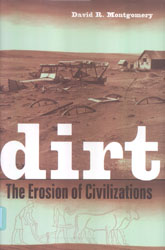
Dirt:
The Erosion of Civilizations
by David Montgomery
S590.7 .M66 2007
New Book Island, 2nd floor

There aren’t many times when you look at the books on the shelves and see dirt (dust, maybe – dirt, no), but that’s the topic of this week’s featured book.

Montgomery, professor of earth and space sciences at the University of Washington, opens his book by relating his experience of falling into boiling quicksand in the Philippines. As he recalls, “Few things can make you feel as helpless as when the earth gives way beneath your feet.” He goes onto examine the civilizations of Mesopotamia, Greece, the Roman Empire, China, European colonialism, Central America and the American West and the use and abuse of dirt. He finds that we’re actually running out of dirt, albeit it slowly. With chapter titles like ‘Westward Hoe’ and ‘Dirty Business,’ this book will definitely open your eyes to a whole new way of thinking about what supports you and the world.

Posted in new stuff tuesdays | Tagged , , , , | Comments Off on New Stuff Tuesday – February 5

First Stop: Class Assignment Guides

Now that the semester is officially underway (and the Super Bowl is over), you might actually have started to think about starting to work on research projects for your courses. A great place to start your research would be the class assignment guides. Have you had an instruction session about library resources in your class – you know, either when taking a field trip to the library or having a librarian come to your classroom? Chances are pretty good that there’s a class guide made just for the project that you have to research. The guides contain links to library resources as well as credible Internet sites to begin the research process.

To find the class assignment guides, hover over Guides on the Library’s home page and click on Class Assignments or use the following link to go there directly: Class Assignment Guides.

Posted in online @ the library, tips for research | Tagged , , , | Comments Off on First Stop: Class Assignment Guides

Hooked on Shelving Worked For Me!

Library of Congress (LC) classification can be a little confusing. With the mix of letters and numbers that really only mean something to librarians, getting a book off the shelf for the first (or sixteenth) time may be a challenge. I can identify, I still struggle because I grew up on Dewey.

Who said learning how to find a book on the shelf meant that you actually had to practice with real books and real stacks? Grad students worked with librarians at Carnegie Mellon University to develop online games to practice, literally, by shelving books. They’ve also developed a game to familiarize yourself with the various resources available at the library, like the print and electronic collections. I did pretty well with the shelving game, but not with the other one. I’ll have to keep trying.

Library Arcade from Carnegie Mellon University – thanks to Anne for the link!

As an aside – which is better? LC or Dewey? I did a quick Google search. The best reason why LC is better – the call numbers fit better on the books (from Aquinas College Library after their reclassification project).

Posted in around the world | Tagged , | 1 Comment

Free File federal taxes online!

Earlier I blogged about where to find tax forms in print. Of course, you can also file online. And if your 2007 adjusted gross income is under $54,000, you can prepare and file your federal taxes online for free–aka Free File!

Free File logo

To take advantage of Free File you must start at the IRS web site. From there you can select one of the companies partnering with the IRS to provide this free filing service. Read each company’s criteria to be sure which companies you can use.

Among the advantages of Free File:

  • a fast refund (within 10 days with direct deposit)
  • 24/7 filing convenience

What if your adjusted gross income is too high to qualify for Free File? You can still file online, but not for free.

Wisconsin also has a free-file option. Go to http://www.revenue.wi.gov/ for more information, including a listing of circumstances/forms that render you ineligible for it.

Government Printing Office logo

The University Library is a federal depository with many federal, state, local, and international documents on a variety of current and relevant issues available to you in print, microfiche, CD-ROM, and electronically. Come check out your government at the University Library!

Posted in info.gov | Tagged , , | Comments Off on Free File federal taxes online!

Subscribe To Our Blog!

Do you like reading our blog? We try to have some fun with it, as well as keep you up-to-date on what’s going on around here – no, we don’t sit around reading all day.

The blog migration to WordPress has caused the blog URL to change to http://blogs.uww.edu/library/ – now it makes more sense. If you’ve already subscribed to the blog, please update your feed URL to http://blogs.uww.edu/library/feed.

Not sure what to do when it comes to subscribing? Check out the original post for subscription information as well as RSS readers.

Posted in around the library | Tagged , , | Comments Off on Subscribe To Our Blog!

New(er) Stuff Tuesday – January 29

Today’s featured stuff is actually something that we got back in April – ScienceDirect College Edition from Elsevier. Recently (and without much notice or fanfare), our subscription greatly expanded. When we first acquired ScienceDirect, our collection included the most current four years of over 1900 journals. That’s not too shabby, especially since Elsevier published many of the top scholarly journals in a number of areas.

We now have access to all of the articles, in electronic full text format, for those journal titles back to 1995! That means that you can read more than eight million articles online! Wow!

You can get to articles from ScienceDirect by searching the collection directly (go to FindDatabases from the Library’s home page). The articles also come up in searches in EBSCOhost, Proquest and databases from other providers – just use the Find It! link to access them!

Posted in new stuff tuesdays | Tagged , , , , | Comments Off on New(er) Stuff Tuesday – January 29

Our Natural World lecture series

Each semester UWW faculty/staff provide a lecture series at the Fairhaven Retirement Community’s Fellowship Hall, easily walkable from campus (435 W. Starin Road). Lectures are on Mondays at 3pm, and they are open to the public. The spring series is called “Our Natural World:”

  • Jan. 28 Impacts of White-tailed Deer in Wisconsin Forests (Stephen Solheim, Biological Sciences)
  • Feb. 4 The Wolves of Yellowstone National Park (George Clokey, Biological Sciences)
  • Feb. 11 History of the Wisconsin River (Dale Splinter, Geography/Geology)
  • Feb. 18 A Radical View of Wisconsin Native American Effigy Mounds (Rex Hanger, Geography/Geology)
  • Feb. 25 “Nature in the City”: Chicago’s Green City Movement (Jeffrey Zimmerman, Geography/Geology)
  • Mar. 3 The Glacial History of Whitewater (Peter Jacobs, Geography/Geology)
  • Mar. 10 Less Waste & More Efficiency: Twelve Principles of Green Chemistry (Paul House, Chemistry)
  • Mar. 17 Real World Cases in Green Chemistry (Hassimi Traore, Chemistry)
  • Mar. 31 Contaminants and the Fate of Wisconsin Waters (Elisabeth Harrahy, Biological Sciences)
  • Apr. 7 Pollination Biologic Sciences in Two Wisconsin Plant Species (Neil Sawyer, Biological Sciences)
  • Apr. 14 Earth and Fire: Volcanism Around the World (Juk Bhattacharyya, Geography/Geology)
  • Apr. 21 Carnivorous Plants: Wonders of the Natural World (Terre Golembiewski, Biological Sciences)

More information on these and related topics could be found using Library resources–books, journal articles, government publications, and more. Here are a couple of examples, relevant to the first two lectures in the series:

  • Article title: Direct and indirect effects of white-tailed deer in forest ecosystems
    Journal: Forest Ecology and Management. (2003) vol.181(1-2): pp.165-176
    Available online through the Library’s subscription to ScienceDirect.
  • Book title: Yellowstone wolves in the wild
    Publication info: Helena, MT : Riverbend Publishing, 2003.
    Available in the Library’s 3rd-floor Main Collection QL737.C22 H343 2003

For assistance in researching these topics, please contact a Reference librarian (come into the Library, phone 262-472-1032, or email/chat).

Posted in around the world, campus connection | Tagged , , , , | Comments Off on Our Natural World lecture series

You Read?

It’s Friday! It’s pretty slow around here, but the blog migration to WordPress (which is fantastic, by the way) is keeping me busy.

That doesn’t mean there’s no time for fun. Get this – this guy read an entire book! Who does that?!

Area Eccentric Reads Entire Book courtesy of the Onion

Thanks Carrie for the link!

Posted in around the world | Tagged , | Comments Off on You Read?

Reading for other views: Utne

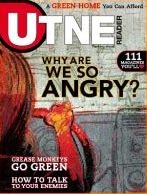
Utne Reader cover

Last semester I blogged about the value of reading a daily newspaper. That’ll get you the mainstream perspective on things. I also recommend reading Utne (previously Utne Reader), which is like a Reader’s Digest of “alternative” (non-mainstream) and independent press, meaning it collects, summarizes, synthesizes, cites and sometimes reprints material selected as the best from other publications. Although its mission is to provide “the best of the alternative press,” there are original Utne articles also. I think of it as a timesaver, kind of like getting a discussion list in digest mode. I’m interested in perspectives and issues that may not hit my radar otherwise, but let the Utne staff sift through 1,500 publications and just lead me to the top-drawer stuff–and give it to me succinctly please!
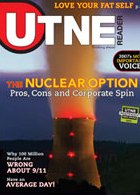
Utne Reader cover

The bimonthly Utne issues are available in the Library’s 1st-floor Periodicals Collection. Sorry, no full text articles online in the Library’s databases, but you can scan the table of contents or search for topics using the online database Academic Search Premier: Click on “Publications” and in the “Browse Publications” box search for utne. A list of years will appear. Pick a year and the issues for that year will appear. Select an issue and the list of articles in that issue will display.

Topics of articles in each issue are all over the map, from the arts and media to science and politics, so there’s something for everyone. Each issue also has a featured topic, e.g., the March/April 2005 issue’s featured topic was “The Future of God” and July/August 2007 was “The Ugly Americans: What Will It Take to Win Back the World’s Trust?”
Examples of articles in recent issues:

  • The dark side of soy – is America’s favorite health food making us sick? (July/August 2007)
  • Redeeming America – what it will take to win back the world (July/August 2007)
  • Vikings with amps – Norse mythology meets power chords in Tyr’s mighty music (July/August 2007)
  • Shuck and jive – how industry and politicians are harvesting ethanol for all it’s worth (May/June 2007)
  • Our furry, feeling friends – the difference between animals and humans isn’t as big as people think (May/June 2007)
  • Midwifery’s renaissance (March/April 2007)
  • Putting a stop to slave labor – a moral solution to illegal immigration (March/April 2007)
  • Cairo’s man show – in Egypt, public male-on-male affection isn’t queer, it’s commonplace (March/April 2007)
  • Grief goes online – the boon and bane of virtual bereavement (March/April 2007)
  • Playing with our heads – why video games are making our kids smarter and more obedient (January/February 2007)
  • Steeped in tea – the social significance of one hot drink (January/February 2007)

The Utne.com web site offers fare similar to its print articles, including enewsletter/blog categories Arts, Environment, Great Writing, Media, Politics, Science and Technology, and Spirituality. You can add your own replies and sign up to have new entries sent to your email.

Posted in around the library, tips for research | Tagged , , , | Comments Off on Reading for other views: Utne